An Accessible Hotel Room May Not Have the Features You Need
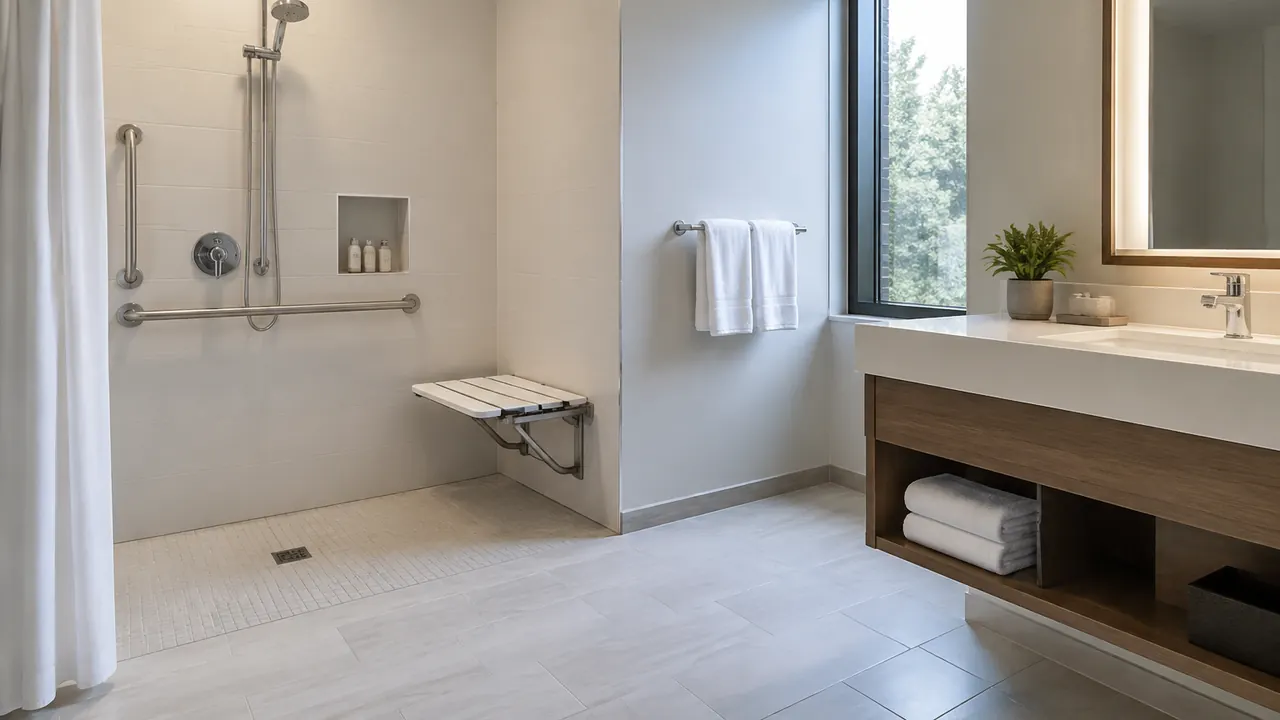
An “accessible” hotel room is not a promise that every feature will work for you. A roll-in shower may lack the seat you need. A bed may be too high for a safe transfer. A bathroom may have grab bars but not enough usable space on the side where you transfer. These differences matter whether you use a wheelchair, walker or cane, travel with a caregiver, or need a step-free route because of pain or limited stamina.
For travel in 2026, treat an accessibility filter as a starting point, not a completed room assessment. The goal is to match a specific room’s layout to your essential needs before money becomes nonrefundable. Ask the property for measurements and current photos, then get its answers in writing. A generic listing, an old review or a reservation note saying “accessible room requested” leaves too much unresolved.
1. Translate “accessible” into your nonnegotiable features
Start with a short list of features you must have, separate from those that would simply be helpful. Describe the task you need to perform: transferring from the left side of your wheelchair, showering while seated or getting a mobility scooter through the bathroom doorway. That gives hotel staff something more useful than a broad question such as “Is your room ADA compliant?”
For U.S. hotels covered by the Americans with Disabilities Act’s reservation rules, reservation services must describe accessible features in enough detail for travelers to assess whether a property meets their needs. Those rules do not make every accessible room identical. Mobility-accessible features and communication features address different needs, and a hearing-accessible room alone may not provide the bathroom or maneuvering space you require.
Use your equipment’s actual dimensions, including protruding wheels or accessories, rather than guessing from its product category. If another person helps you transfer or bathe, include space for that person. Avoid sending a detailed medical history; explain the functional features you need.
- List must-haves first: shower type, transfer side, usable bed height and minimum clear doorway width.
- Identify equipment you will bring, including a shower chair or portable lift, and the space it requires.
- Ask which exact room category includes all those features, not whether the hotel has them somewhere.
2. Ask what “roll-in shower” actually means in that room
A bathtub with grab bars, a transfer shower and a roll-in shower are not interchangeable. A transfer shower is designed around moving onto a seat; a roll-in shower provides an entry intended to accommodate wheeled access. Neither label tells you every detail about the seat, controls or space outside the shower. Ask for the actual configuration in the category you are booking.
Request photos showing the entrance, floor, seat, grab bars and shower controls together. Ask whether there is a lip or threshold, how high it is, and whether doors or fixed glass narrow the opening. If you need a seat, establish whether it is fixed, folding or portable, its dimensions and rated capacity, and whether it will be available for your entire stay. Do not assume a loose shower chair is suitable for transfers.
- Can someone measure the clear shower entrance and the usable floor area inside it?
- Where is the seat relative to the controls, handheld showerhead and grab bars?
- Can the water be started and adjusted while seated without reaching through the spray?
- Is there clear space beside the seat for my transfer method and any assistance?
- Will the requested chair be confirmed, rather than offered only if available at check-in?
3. Measure the bed, not just the bedroom
Bed height is a frequent mismatch because “accessible room” does not establish a universally suitable transfer height. Ask staff to measure from the finished floor to the top of the mattress with the bed made normally. A thick mattress or topper can change the result. Explain your workable range rather than asking whether the bed is “low.” A mattress’s softness also affects transfer stability, although a phone description cannot fully establish how it will feel.
Verify the open floor space on the side you actually use, not just the widest side shown in a promotional image. Ask whether a nightstand, platform base or fixed furniture intrudes into that space. If you use a portable lift, request under-bed clearance height and depth, plus photos of the frame and supports. A platform bed may prevent a lift’s legs from going underneath even when the room itself is spacious.
If staff propose removing a frame, shifting furniture or providing another bed, get management approval and the resulting measurements in writing. Do not plan on making those changes yourself. Ask whether the modification can be completed before arrival and whether the room will still have a clear route to the bathroom and exit.
4. Check every doorway and the route beyond it
A room can have a wide entry door and a much tighter bathroom entrance. Request clear opening measurements, not the width of the door slab or frame. For a hinged door, explain that you need the usable opening with the door open 90 degrees, measured between the door face and opposite stop. U.S. accessibility standards generally use a 32-inch minimum clear opening for doorways, with specified exceptions, but your equipment and approach may require more.
A straight doorway measurement is only part of the test. Tight turns, deep recesses, heavy doors and thresholds can make an otherwise wide opening difficult to use. Ask for photographs from both sides, especially where the bathroom door meets the bed or a hallway wall. Confirm that the room’s current furniture arrangement matches the photos, and request threshold heights along the route.
- Give staff your needed clearance, including hands on push rims or equipment accessories.
- Ask whether a person using your equipment can turn into the opening, not merely pass through it.
- Check any balcony or patio separately; an accessible bedroom does not establish an accessible outdoor route.
| Location | Ask staff to verify | Why it matters |
|---|---|---|
| Guest-room entry | Clear opening, threshold and door closer | Entry may require both clearance and strength |
| Bathroom doorway | Clear opening and door swing | The door can block a transfer area |
| Bedside approach | Narrowest passage and turning space | Room size alone does not show usable access |
| Connecting door | Each door’s clearance and threshold | An adjoining room may not have a usable connection |
5. Map the bathroom around your transfer
Request a full bathroom photo or a simple sketch showing the toilet, sink, shower and door. Identify the toilet transfer side as you face the toilet, so “left” and “right” are not ambiguous. Ask for toilet seat height and usable clearance beside and in front of it. A wastebasket can often be moved; a vanity, wall or shower partition cannot. Verify grab-bar placement rather than accepting “there are rails.”
For the sink, ask about knee and toe space, exposed pipes and whether you can reach the faucet, soap and towels from your usual position. Wall-mounted fixtures may look accessible in a photo while a cabinet, shelf or bin blocks the approach. If you need to remain seated for grooming, also check the mirror position and whether there is a reachable outlet for necessary personal equipment.
- Does the bathroom door swing into the space needed for a toilet or shower transfer?
- Can the door close with my mobility device and, if needed, a helper inside?
- Are grab bars fixed, and where are they in relation to the toilet and shower seat?
- Can staff send measurements with the photos, rather than asking me to judge scale from an image?
6. Confirm the elevator and the whole arrival route
A suitable room is not useful if you cannot reliably reach it. Trace your route from the parking area or drop-off point to reception, the elevator and the room. Ask whether the step-free entrance is the main entrance, whether it is available around the clock and whether any segment requires staff to unlock a door or operate a lift. A side entrance may be workable, but you should know the arrangement before a late arrival.
For elevator access, confirm the door opening, usable cab dimensions and space to approach and turn, particularly with a large scooter. Ask whether the elevator serves the actual room floor without intervening steps. A property with several wings may have different routes and elevators; “we have an elevator” is not enough. Also ask about scheduled maintenance or construction during your dates.
Find out what happens if that elevator is unavailable. Ask whether another accessible route or an appropriate ground-floor room exists, without assuming either can be guaranteed. Discuss emergency procedures with the property in advance; do not assume an ordinary passenger elevator will be usable during a fire. Make sure you understand how to contact staff for assistance.
7. Turn the answers into a written reservation record
Contact the property directly when a booking platform cannot answer detailed questions. Ask for someone who can inspect the room, such as an on-site manager. Then email a concise summary: “For reservation [number] on [dates], please confirm a room with a roll-in shower, the described seat, a mattress-top height of [range], and at least [measurement] clear bathroom doorway width.” Add your other essentials and ask staff to correct anything inaccurate.
Distinguish confirmed features from requests subject to availability. For U.S. hotels covered by ADA reservation requirements, accessible rooms have specific reservation and holding protections, including guarantees concerning the reserved accessible room. That is stronger than an informal preference, but it does not eliminate operational problems. Ask what the hotel will do if your confirmed room or an essential feature becomes unavailable.
Save the room-category description, photos, measurements, correspondence and cancellation terms. Reconfirm shortly before arrival and ask to be notified of substitutions or equipment failures. Written confirmation creates a useful record; it is not proof that a layout will work. If an answer remains vague, resolve it before your cancellation deadline or choose a property that can verify your essentials.
Accessibility details and hotel policies can change; verify current room features, reservation protections and cancellation terms directly with the property before committing.
AI Assistance Used — AI assistance was used in researching and drafting this article. It was reviewed, edited, and fact-checked by Jordan Singh before publication.