Travel Adapter or Voltage Converter? Avoid Damaging Your Devices
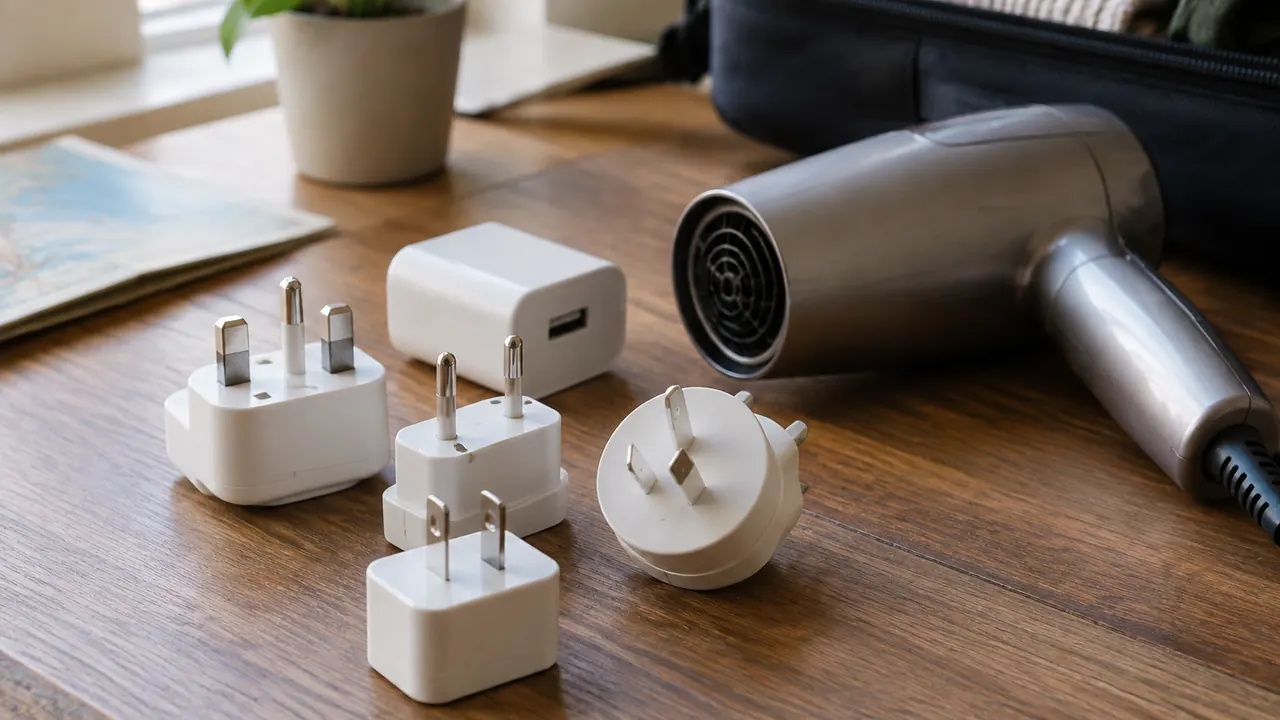
A phone charger and a hair dryer can have similar-looking plugs but very different needs overseas. One may work with a simple travel adapter; the other may overheat or fail on the same outlet. The difference is not the device’s size or price. It is whether its electrical input matches the local supply, and whether every part of the connection can safely carry the power it needs.
For travel in 2026, the most useful packing habit is still decidedly low-tech: read the label before buying accessories. USB-C has simplified charging for many travelers, but it has not made wall voltage universal or turned travel adapters into voltage converters. Work through three questions for each item: Will the plug fit? Is the voltage compatible? Is the power demand within the equipment’s limits?
1. Separate plug shape from electrical compatibility
A basic travel adapter changes the physical connection between your plug and an outlet. It does not change the electricity supplied through its AC socket. A voltage converter or transformer changes voltage, but that alone does not guarantee compatibility with a particular appliance. Outlet frequency, grounding and the converter’s intended uses also matter. Most ordinary travel converters do not change frequency.
The United States generally supplies household outlets at about 120 volts and 60 hertz. Many destinations use about 230 volts and 50 hertz, while others use different combinations. Plug shape is not a reliable voltage guide: countries with similar-looking outlets can have different electrical supplies. Verify the destination’s voltage, frequency and outlet types through a reliable travel resource or the accommodation, particularly for multi-country trips. A plug that slides neatly into place proves only that it fits, not that turning on the appliance is safe.
- Check each destination, including overnight stops where you expect to charge.
- Treat voltage, frequency and plug shape as separate checks.
- Do not assume a hotel’s convenient-looking socket supplies US voltage.
| Item | What it does | What it does not guarantee |
|---|---|---|
| Plug adapter | Changes the physical plug connection | Compatible voltage or frequency |
| Voltage converter or transformer | Changes AC voltage within its specifications | Compatibility with every appliance |
| USB wall charger | Converts supported AC input to USB power | Enough output for every connected device |
| Adapter with USB ports | Combines plug adaptation with USB charging | Voltage conversion at its AC outlet |
2. Read the charger’s input label, not just its USB output
Start with the small print on the charger that plugs into the wall. Look for INPUT, followed by a voltage range and frequency. A label reading 100–240V, 50/60Hz generally means the charger accepts ordinary household supplies across that range without an external voltage converter. You still need the correct plug connection and must follow its instructions. The OUTPUT line describes electricity delivered to the device; it does not tell you which wall voltage the charger accepts.
A label reading only 120V, 60Hz is a different case. Do not connect that product to a 230-volt supply through a plug adapter alone. Likewise, do not assume a device is internationally compatible because it is new, expensive or charges a familiar brand of phone. Read the actual charger, since replacement accessories can differ from the original. If the label is worn away or ambiguous, find the manufacturer’s manual for the exact model rather than guessing.
- 100–240V, 50/60Hz: usually suitable for both common voltage systems with an appropriate adapter.
- 120V only: not suitable for direct connection to a 230-volt outlet.
- 110/220V selector: check the manual and set it correctly before connecting.
- Unreadable or missing rating: pause until the manufacturer confirms compatibility.
3. Match wattage to the entire setup
Voltage compatibility is only half the safety check. Every adapter, converter, cord and outlet connection has a maximum electrical load. The lowest applicable rating governs the setup. An adapter rated for a modest load is not suitable for a powerful appliance simply because the appliance’s voltage is correct. Look for ratings in watts or amps, and pay attention to whether the manufacturer specifies different limits at different supply voltages.
For a basic capacity check, volts multiplied by amps gives volt-amperes, which roughly equals watts for a simple heating load. An adapter marked 6A has an approximate resistive-load ceiling of 720 watts at 120 volts or 1,380 watts at 230 volts, unless its instructions impose a lower limit. That calculation does not establish converter suitability for motors or electronics. Use the appliance’s stated input demand and the accessory manufacturer’s compatibility rules. A laptop charger’s advertised USB output wattage is not necessarily its maximum wall input.
- Add the loads of devices used simultaneously on a shared AC connection.
- Check continuous-use limits, not just a prominently advertised peak rating.
- Account for motor starting requirements when the converter manufacturer specifies them.
- Never assume a built-in fuse makes overloading acceptable or prevents all damage.
4. Give hair dryers, straighteners and kettles extra scrutiny
High-heat appliances are where packing convenience most often collides with electrical limits. Hair dryers, curling irons, straighteners, garment steamers and travel kettles may draw far more power than charging electronics. Many US models are designed only for 120 volts. Connecting one to a higher-voltage supply through an adapter can damage it and create a fire or burn hazard. Turning the heat setting down does not make an incompatible appliance safe.
Some travel appliances genuinely support both voltage systems, but the details vary. A dual-voltage hair dryer may require a manual switch adjustment while unplugged, and its permitted speed or heat settings may differ abroad. Other products switch automatically. Follow the exact model’s instructions rather than advice for a similar-looking appliance. For a short trip, using the accommodation’s locally compatible dryer or buying an appropriate appliance at the destination is often simpler than carrying a correctly sized converter. Ask what is provided before deciding.
- Leave a high-wattage, single-voltage appliance home if compatible conversion is uncertain.
- Check both the appliance rating and the adapter’s load limit.
- Do not treat a low-power bathroom shaver socket as a hair-dryer outlet.
- Avoid using electrical appliances near water, regardless of voltage compatibility.
5. Buy a converter only for a clearly defined need
A converter is not a universal rescue device for anything labeled 120V. Products sold under that name use different designs and have different restrictions. Some compact travel converters are intended only for certain heating appliances and limited operating periods. They may be unsuitable for electronic controls, battery chargers or motorized products. A transformer can serve different needs, but a model large enough for a powerful appliance can be heavy and impractical.
For a US appliance on a higher-voltage supply, you would generally need step-down conversion, not step-up. Confirm the required direction, input and output voltage, continuous capacity, permitted appliance types and operating duration. Also check frequency: lowering 230 volts to 120 volts does not normally turn 50 hertz into 60 hertz. Motors, timers and other frequency-sensitive equipment may still be incompatible. If the appliance maker and converter maker do not clearly support the combination, do not experiment. For medical equipment, obtain travel instructions directly from the manufacturer or equipment provider well before departure.
6. Choose adapters that preserve the safety features you need
A universal adapter can be convenient, but the name does not mean it covers every country, socket or appliance. Check its supported destinations, voltage and current ratings, and grounding arrangement. Some adapters accept a three-prong plug without carrying a protective ground through to the outlet. That is not an appropriate workaround for equipment that requires grounding. Do not remove a ground pin or defeat another safety feature to make something fit.
Buy from a traceable seller and look for applicable, verifiable safety certification for the product and market, rather than relying on vague claims such as safety approved. Inspect the adapter before travel for loose pins, cracks and signs of overheating. A compact charger supported securely at the wall is preferable to a heavy stack of adapters that pulls away from the socket. Avoid daisy-chaining adapters or attaching a US power strip unless its manufacturer explicitly permits the destination’s supply voltage and your intended use. US surge-protection components may be unsuitable for higher voltages even when the connected chargers are compatible.
7. Build a charging plan before you pack
For phones, tablets and laptops, a reputable multiport charger with the correct input range can reduce clutter. Check its total output and how power is divided when several ports are used. A charger advertised at a particular wattage may deliver that amount only through one port under specified conditions. USB-C describes the connector, not a guaranteed charging speed; the device, charger and cable must support the required power level.
Make a short list of what will plug into the wall, photograph each input label and match each item to the destination’s supply. Pack only the adapters those approved combinations need, plus suitable charging cables. Keep the list accessible if you buy replacements while traveling. At your accommodation, check that the outlet is intact and holds the plug securely. Stop using any setup that sparks repeatedly, smells scorched, buzzes unusually or becomes excessively hot. When a questionable appliance is optional, leaving it home is usually the safest and lightest solution.
For uncertain electrical compatibility, consult the equipment manufacturer or a qualified electrical professional before connecting the device.
AI Assistance Used — AI assistance was used in researching and drafting this article. It was reviewed, edited, and fact-checked by Jordan Singh before publication.