Smoke and Carbon Monoxide Alarms: What to Check in 2026
Smoke and carbon monoxide alarms are easy to overlook until one starts chirping. But silence does not prove an alarm is ready, and a glowing power light does not tell you whether its sensor has reached retirement age. A useful household check in August 2026 starts with four questions: Are the right alarms in the right places? Do they pass their prescribed tests? Are they within their service lives? Will everyone know what to do when they sound?
Connected features add another question: What happens when the internet, electricity or phone service fails? Remote notifications can be useful, especially when nobody is home, but they are a secondary layer. Start with working local alarms and the requirements that apply to your address, then decide whether an app adds enough value to justify its cost and upkeep.
1. Check coverage room by room
Start with a floor-by-floor sketch, including the basement and every sleeping area. Widely used U.S. fire-safety guidance calls for smoke alarms inside each bedroom, outside each separate sleeping area and on every level, including the basement. A hallway alarm alone is not a substitute for alarms inside bedrooms. Closed doors can slow smoke reaching a hallway detector and reduce how well its sound carries.
For carbon monoxide, commonly called CO, place alarms on every level and outside each separate sleeping area, following the product instructions. CO is an odorless, colorless gas; a smoke-only alarm does not detect it. A combination unit detects both only if it is specifically labeled for both functions. Fuel-burning appliances, fireplaces and attached garages are important reasons to check CO coverage, but do not assume an all-electric home is automatically exempt from local requirements.
Treat this layout as a starting point, not a code determination. State and local rules can differ for existing homes, new construction, renovations and rentals. Ask the local building department or fire-prevention office what applies, particularly after adding a bedroom or converting a basement.
- Mark smoke-only, CO-only and combination alarms separately on your sketch.
- Include guest rooms and other rooms regularly used for sleeping.
- Flag missing alarms, unreadable labels and areas where closed doors could limit audibility.
2. Put each alarm where it can work
Smoke alarms generally belong on ceilings or high on walls, with exact clearances determined by their instructions. Pitched ceilings, beams and unusual room layouts need special attention. Avoid locations where supply vents, ceiling fans or drafts could interfere with smoke reaching the sensor. Do not simply reuse an old mounting spot without checking whether it was appropriate.
Cooking smoke and shower steam can cause nuisance alarms. General fire-safety guidance recommends keeping smoke alarms at least 10 feet from cooking appliances to reduce unwanted activations, but product instructions and applicable code determine the permitted arrangement. Bathrooms also require attention to separation from steam. For a tight apartment layout, ask the fire-prevention office for guidance rather than deleting an alarm or moving it far from sleeping rooms.
CO alarms are not all mounted at the same height. Depending on their design, they may be ceiling-mounted, wall-mounted or plugged into an outlet; follow the listed installation instructions. Keep them away from locations the manufacturer excludes, including excessive heat, humidity or direct appliance exhaust. Ordinary household alarms generally do not belong in unfinished attics or garages unless specifically rated for those conditions. For spaces needing specialized detection, consult a qualified installer rather than improvising.
3. Understand power and interconnection
Battery-powered, hardwired and interconnected describe different things. The first two identify the power source; interconnection means one alarm can trigger other compatible alarms. A battery-powered model can be wirelessly interconnected, and a hardwired model is not necessarily interconnected just because it receives household electricity. Check the actual installation rather than making assumptions from appearance.
Hardwired alarms commonly have backup batteries, either replaceable or sealed. Confirm the backup type and its maintenance instructions. A power outage should not be when you discover a missing battery. Sealed-battery models simplify battery maintenance, but their whole units still need replacement at end of life or when the instructions identify a battery fault requiring retirement.
Interconnection is especially valuable across multiple floors or separated sleeping areas. However, devices must be explicitly compatible; the same brand name alone is not enough. Do not substitute battery-only alarms for required hardwired units without checking local rules. Have a qualified electrician handle wiring changes and verify the interconnect arrangement.
| Configuration | Main advantage | What to verify |
|---|---|---|
| Replaceable-battery alarm | No household wiring needed | Correct batteries, replacement schedule and code acceptance |
| Sealed-battery alarm | No routine battery swapping | Whole-unit replacement date and activation instructions |
| Hardwired alarm with backup | Household power plus backup | Backup condition, wiring and permitted replacements |
| Interconnected alarm system | Compatible alarms sound together | Approved compatibility and operation during power loss |
4. Test monthly and respond to trouble signals
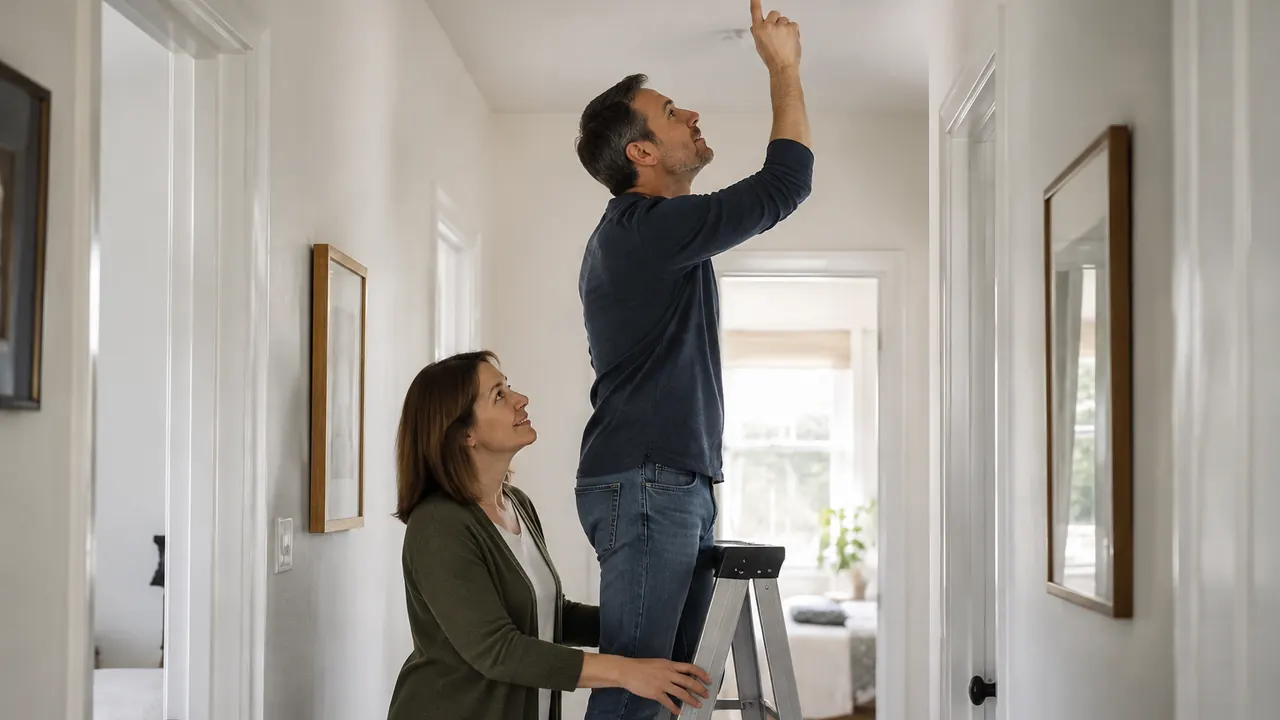
Test smoke and CO alarms at least monthly, using each manufacturer’s procedure. Usually that means pressing and holding a test button, but the duration and expected sequence vary. Tell everyone first, protect your hearing and use a stable stepladder if needed. Check each alarm, and verify interconnection according to the instructions rather than assuming the entire network works.
A button test checks the functions specified by the manufacturer; it is not permission to ignore expiration dates or obvious damage. Never test with an open flame, vehicle exhaust or another improvised source. Use test aerosols only when the manufacturer expressly permits them and follow the directions. Clean alarms as instructed, often by gently vacuuming exterior openings; avoid paint, cleaners and sprays.
Learn the difference between an emergency alarm, a low-battery chirp and an end-of-life or fault signal. Patterns vary, so keep the manual accessible. If you cannot identify a signal promptly, treat a possible emergency seriously rather than assuming it is a maintenance issue.
- Put recurring test reminders on a shared household calendar.
- Use only the battery type specified, and confirm the battery compartment closes properly.
- Replace an alarm that fails its prescribed test after permitted troubleshooting.
- Never leave an alarm disabled because of repeated nuisance activations; correct the cause.
5. Read the replacement date, not just the battery label
Smoke alarms generally need replacement 10 years after manufacture, not 10 years after you remember installing them. Check the back or side for the date and follow any earlier replacement requirement in the instructions. If the manufacture date cannot be established, replace the unit rather than guessing. A fresh battery cannot restore an aging sensor.
CO alarm service lives vary by model, often falling within roughly five to 10 years. Follow the marked replacement date or the manufacturer’s stated service-life calculation; do not automatically apply the smoke-alarm rule. Combination alarms also have model-specific retirement instructions. An end-of-life signal means the alarm needs replacement, not simply another battery.
When shopping in 2026, inspect the manufacture date, replacement labeling and certification before buying, including on discounted inventory. Look for certification by a recognized testing laboratory to the applicable U.S. alarm standard, such as UL 217 for smoke alarms or UL 2034 for CO alarms. A listing does not guarantee that a particular model meets every local installation requirement. Record the model number, installation date and replacement deadline, and keep a photo of the label. Check manufacturer notices and Consumer Product Safety Commission recalls if a unit behaves abnormally or you are evaluating older equipment.
6. Treat smart alerts as an extra layer
A smart alarm may send phone notifications, show battery status or identify which room triggered an event. Those features can help, but the essential question is whether the device provides the required local alarm function without an internet connection. A separate listening accessory that recognizes an existing alarm’s sound is not itself a replacement smoke or CO alarm.
Before paying extra, check what depends on Wi-Fi, a hub, cloud services, a subscription or phone permissions. Remote alerts can fail because of an outage, a muted phone, an expired account or discontinued support. Wireless alarm interconnection and app connectivity are not necessarily the same network. Ask whether alarms still sound together when the router is off, and verify the answer through the manufacturer’s approved test procedure.
Compare ongoing costs and support commitments, not just the purchase price. Confirm who receives alerts and whether any advertised monitoring actually includes emergency dispatch; a push notification alone does not summon firefighters. Recheck these settings after changing phones, routers or household members.
| Feature | Useful question | Limitation to remember |
|---|---|---|
| Phone notifications | Which connections and permissions are required? | Delivery is not guaranteed |
| Wireless interconnection | Does it work without the router or internet? | Only approved compatible devices link |
| Remote status checks | Which faults does the app report? | They do not replace prescribed testing |
| Professional monitoring | What response is included under current terms? | Dispatch is not inherent in a smart alarm |
7. Make sure everyone can respond
Protection depends on people hearing or otherwise receiving the warning. Households with someone who is deaf or hard of hearing should ask about listed notification equipment, such as appropriate strobes and bed shakers. Do not assume a phone vibration will reliably wake a sleeper. Plan help for children and anyone who needs assistance leaving.
For a smoke alarm indicating fire, get outside, stay outside and call 911 from a safe location. For a CO alarm, move everyone outside to fresh air and call 911; do not search for the source first. Do not reenter until responders say it is safe. Headache, dizziness, nausea or confusion can signal CO exposure and require urgent attention.
Practice an escape plan with a meeting place and two ways out of rooms where possible. Renters should report missing, expired or malfunctioning alarms promptly to the landlord in writing and contact local housing or fire officials if problems remain unresolved.
Consult your local fire-prevention or building department and a qualified installer to confirm current requirements and appropriate equipment for your home.
AI Assistance Used — AI assistance was used in researching and drafting this article. It was reviewed, edited, and fact-checked by Nadia Clarkson before publication.