Smart Speakers in 2026: What Actually Matters Before You Buy
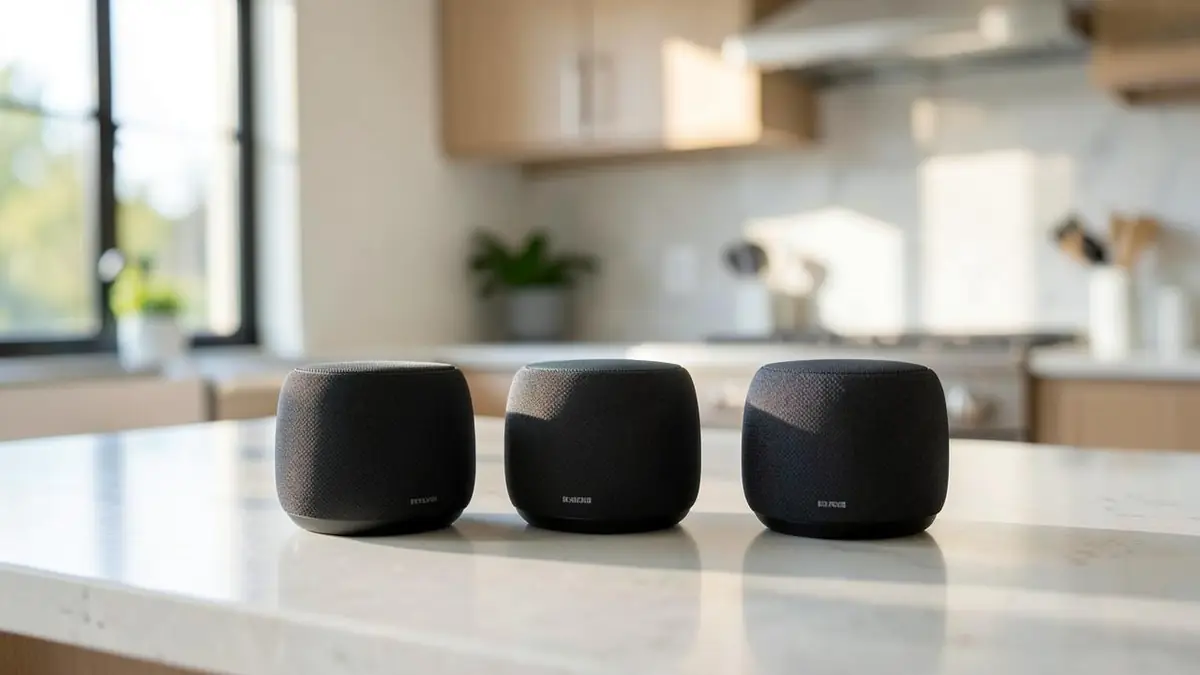
Smart speakers have quietly converged. Every mainstream assistant now handles timers, weather, music, and basic home control competently, and the feature lists have blurred to the point where marketing pages read almost identically. Choosing on assistant capability alone is choosing on a difference that barely exists.
What still varies enormously is sound quality relative to price, how well the microphones work in a noisy kitchen, what the device does with your voice data, and how comfortably it fits the rest of the equipment you already own.
Match the speaker to the room, not the spec
A compact puck is fine for a bathroom or a bedside table, where it is a clock and a radio. It will disappoint in an open-plan kitchen where it competes with an extractor fan and conversation.
For rooms where music actually matters, a larger cabinet with a real woofer is worth the difference. Physics has not changed: bass response depends on driver size and enclosure volume, and no amount of processing fully substitutes for either.
Microphone performance is underrated
The most common daily frustration is not a wrong answer but a device that does not hear the request. Far-field microphone arrays vary widely, and a speaker that responds reliably from across a noisy room is worth more than one with a slightly better speaker driver.
Look for reviews that test wake-word recognition with music playing at volume. That is the realistic condition, and it separates products more sharply than any published specification.
Count the ecosystem cost before the hardware cost
Smart speakers are entry points into ecosystems. The lights, plugs, locks, and cameras you buy afterwards will be chosen for compatibility, and switching later means replacing more than the speaker.
Cross-platform standards have improved, and a growing share of home devices now work with more than one assistant. It is still worth checking that the specific products you own or plan to buy are supported rather than assuming.
Read the privacy controls properly
Every mainstream assistant now offers some combination of a microphone mute switch, a setting to stop storing recordings, and a way to delete history. What differs is which of these are on by default and how deeply they are buried.
A physical mute switch that cuts the microphone circuit is more reassuring than a software toggle. If the device is going in a bedroom or a home office, that hardware detail is worth prioritising.
Consider what happens if the service ends
Smart speakers depend on servers. When a manufacturer discontinues a product line or shuts a service down, the hardware can lose most of its function overnight, and this has happened repeatedly across the category.
Devices that also work as ordinary Bluetooth or line-in speakers keep a floor of usefulness. That fallback is a small feature that becomes the most important one at the end of a product's supported life.
Buying sensibly
Start with one speaker in the room where you will use it most, and live with it for a month before expanding. Multi-room bundles are heavily discounted precisely because they lock buyers in early.
Prices in this category swing dramatically during sales events, often by half. Unless a speaker is replacing something broken, waiting for a promotional window is close to free money.
Assistant features, supported devices, and privacy settings change frequently. Check current manufacturer documentation before relying on any specific capability.
AI Assistance Used — AI assistance was used in researching and drafting this article. It was reviewed, edited, and fact-checked by Leah Fornier before publication.