A Road-Trip Emergency Kit Matched to Your Route
A useful road-trip emergency kit starts with an ordinary problem: a flat tire, a dead starting battery or a long wait for a tow. Then it accounts for where that wait could happen. A suburban interstate, a desert park road and a snowy mountain pass call for different backup supplies, even when the same vehicle can travel all three in one week.
For a 2026 road trip, build your kit in layers rather than buying a large bag and assuming it covers everything. Keep everyday breakdown equipment in the car, add protection for the forecast and terrain, and increase your margin when help is distant. Phone-based navigation, roadside-assistance apps and newer vehicle safety features are useful, but none guarantees a signal, an open road or a prompt rescue.
1. Match supplies to the hardest stretch
Review the entire route, not just the destination's forecast. A warm-weather vacation can include a cold overnight crossing; a paved scenic road can have long gaps between services. Identify the longest stretch without dependable fuel, charging, drinking water or cell coverage. Build around a plausible delay there, including an overnight wait if weather or distance could keep assistance away.
Use this comparison to choose additions, then adjust quantities for passengers, pets, medical needs and cargo space. The categories overlap: a remote desert route needs both heat supplies and an off-grid communication plan. Bring what you can safely store and secure, not equipment that exceeds your skills or your vehicle's capabilities.
- Check elevations, seasonal road restrictions and distances between services, not just estimated driving time.
- Count everyone who needs water, warmth, medication or help moving away from traffic.
- Choose alternate stops and a turnaround point before entering a low-service stretch.
| Route conditions | Add to the everyday kit | Plan for |
|---|---|---|
| Serviced highways | Accessible visibility gear and phone power | A safe wait for roadside assistance |
| Desert heat | Extra drinking water, sun protection and shade | Loss of air conditioning |
| Winter roads | Insulating layers, blankets and approved traction devices | A cold delay or closure |
| Remote roads | Offline maps, extra provisions and suitable backup communication | A longer wait without cell service |
2. Inspect the vehicle before packing
An emergency kit cannot compensate for worn tires, an overdue repair or a weak battery. Well before departure, follow the owner's maintenance schedule and address warning lights, leaks, unusual noises and starting problems. A qualified shop can assess anything uncertain while there is still time for repairs. Check cold tire pressure against the driver's door placard or owner's manual, not the maximum pressure molded into the tire sidewall.
Inspect tread and visible tire damage, including the spare if equipped. Check appropriate fluid levels according to the manual, along with wipers, exterior lights and washer fluid suited to expected temperatures. Know whether your vehicle carries a spare, a sealant-and-inflator kit or neither. Confirm that any sealant is within its expiration date and understand its limits: sidewall damage and major punctures generally require different help.
For an EV or plug-in hybrid, review charging stops, backup sites and compatible connectors or adapters; confirm access hours where relevant. Cold, heat, speed, hills and towing can change range. A portable jump pack does not recharge a depleted traction battery. For any powertrain, verify roadside coverage, towing-distance limits and exclusions for unpaved or remote roads before assuming a tow will be covered.
3. Keep an everyday breakdown kit accessible
Pack core equipment where you can reach it without unloading luggage beside traffic. Keep a charged phone, charging cable and power bank available in the cabin. Store heavier supplies securely so they cannot become projectiles during a crash. Check batteries, expiration dates and missing items before each major trip; a flashlight that worked last summer may be useless now.
Choose tools you know how to use. A jump pack must be suitable for the vehicle and used exactly as both manuals direct, especially on hybrids and EVs. Tire-changing equipment is useful only when there is a firm, level location safely away from traffic. Never get beneath a vehicle supported only by its emergency jack.
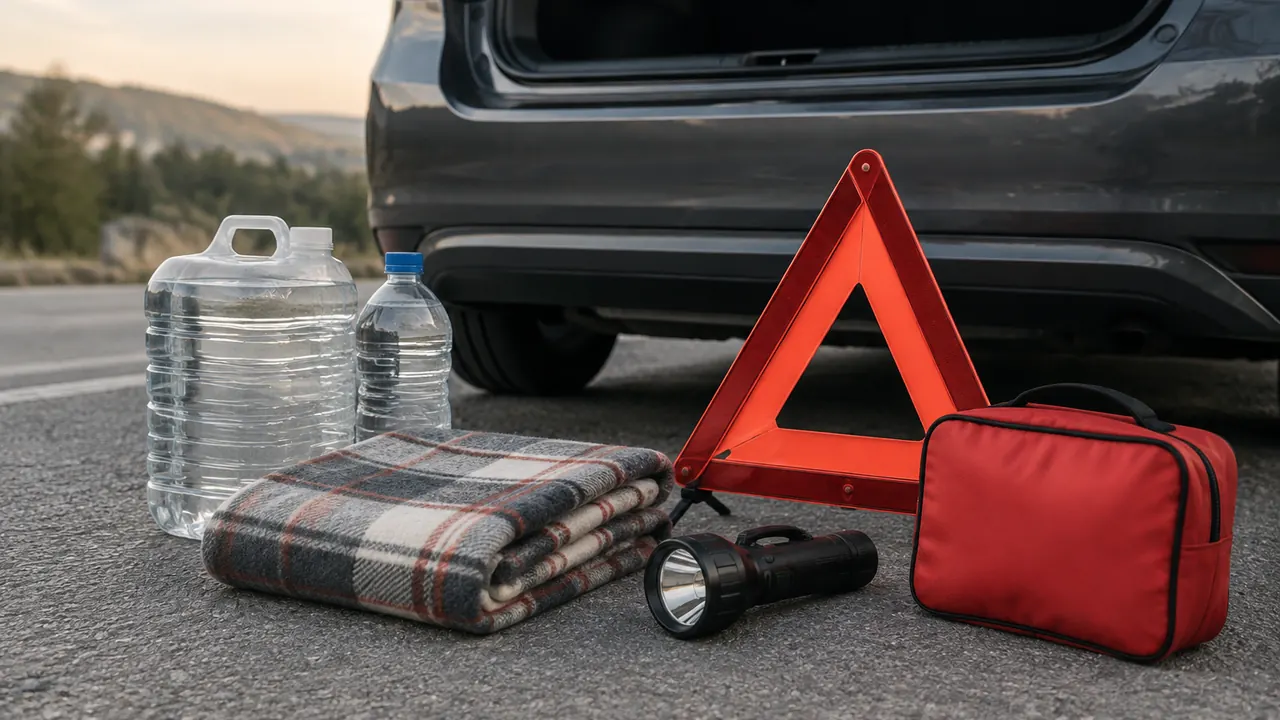
- Visibility: a reflective vest, flashlight or headlamp, spare batteries and reflective warning triangles; place markers only when doing so is safe.
- Tires and starting: pressure gauge, suitable inflator, factory tire equipment and a compatible, charged jump pack if appropriate.
- Personal needs: drinking water, shelf-stable snacks, basic first-aid supplies, essential medications and needed medical-device power.
- Small practical items: work gloves, paper towels, trash bags, basic tools and a paper copy of roadside-assistance and emergency contacts.
4. Add water and shade for desert heat
In desert conditions, losing air conditioning can quickly turn a mechanical delay into a health emergency. Carry drinking water separately from anything intended for vehicle use. One gallon per person per day is a common emergency-planning baseline, not a ceiling or a prescription for how much to drink. Heat, exertion, trip length, pets and individual needs can require more. Build a reserve for delays rather than packing only what you expect to consume while driving.
Use sturdy, food-safe containers and divide the supply so one leak does not ruin your reserve. Add hats, sunscreen, light protective clothing and a workable shade option. A windshield shade reduces solar heating but does not make a parked car safe for people or pets. Keep medication within its labeled storage range; a parked trunk can become extremely hot.
If stranded, seek the safest available shade and minimize exertion. Do not start walking toward distant-looking buildings or traffic without a clear, safe plan; desert distances are deceptive. Confusion, collapse or other signs of heat stroke require emergency help and immediate cooling. Never leave a child or pet in a parked vehicle, even briefly, and do not open a hot cooling-system cap.
5. Pack winter protection before the pass
Winter additions should protect people even if the engine or cabin heat becomes unavailable. Bring insulating layers, hats, gloves, warm socks and substantial blankets or sleeping bags appropriate to expected conditions. A thin reflective emergency blanket is a supplement, not an equal replacement for insulation. Keep footwear suitable for snow within reach rather than buried under luggage.
Check the rules for every mountain corridor. Tire requirements and chain controls vary by jurisdiction, vehicle and conditions; all-wheel drive does not provide an exemption everywhere. Use only traction devices permitted for your vehicle's tire size and clearance, and practice installing them before departure. If a road closes or conditions exceed your equipment or ability, stop at a safe place or turn back.
If snow strands you, staying with the vehicle is generally safer than walking into poor visibility. Call for help and share your location. Before running an engine for warmth, ensure the exhaust outlet is clear of snow and remains clear as drifting continues. Carbon monoxide can be deadly; never run an engine in an enclosed space.
- Add an ice scraper, snow brush and compact shovel.
- Carry dry replacement clothing in a water-resistant bag.
- Pack extra food, water and necessary medication for a prolonged closure.
- Charge devices before the pass and preserve backup power for communication.
6. Give remote roads a separate backup plan
Remoteness changes the consequences of a small failure. Download maps before losing service, save key locations and carry a paper map for a useful overview. Tell someone your intended route, overnight stops and expected check-in time, with instructions for what to do if you miss it. Update that person when plans change; an obsolete itinerary can send help to the wrong place.
Do not assume your phone's satellite feature works everywhere or supports every kind of message. Capabilities depend on the device, service, region and access to the sky. Verify setup and practice any available demonstration before departure. A dedicated satellite messenger or personal locator beacon may suit some routes, but these devices differ in messaging, subscriptions and rescue-alert functions.
Increase food, water and weather protection for a longer wait. Set conservative fuel or charging turnaround margins and verify whether remote stations actually operate when you expect to arrive. Do not carry loose fuel containers inside the passenger compartment. Recovery straps and other off-road gear require suitable attachment points and training; improvised recovery can cause severe injury. Some routes call for another vehicle or a guide.
7. Check closures, then use the kit safely
Check official state transportation or 511 information, National Weather Service forecasts and alerts, and park or land-management notices shortly before departure and again before vulnerable stretches. Navigation apps can lag behind closures or suggest unsuitable detours. For an August departure, heat, wildfire-related restrictions and flash flooding deserve attention; later travel may bring snow. Never drive around a barricade or enter floodwater.
If trouble starts, move out of travel lanes when possible and activate hazard lights. Whether to remain belted inside or exit depends on traffic, fire, terrain and your stopping location. Do not stand beside the vehicle in an exposed lane or attempt a repair there. If safe exit is possible, use the side away from traffic and move to a protected location.
Call 911 for immediate danger, injury or a vehicle creating a serious traffic hazard; use roadside assistance for a routine breakdown in a safe location. Give the road name, direction, nearest exit or mile marker and coordinates if available. Supplies buy time and reduce exposure. They do not make a closed road passable or a neglected vehicle reliable.
Consult your owner's manual and a qualified technician for vehicle-specific equipment and maintenance advice, and verify current road restrictions and assistance coverage before departure.
AI Assistance Used — AI assistance was used in researching and drafting this article. It was reviewed, edited, and fact-checked by Leah Fornier before publication.