Cash Rebate or Low-APR Auto Loan: Which Deal Saves More?
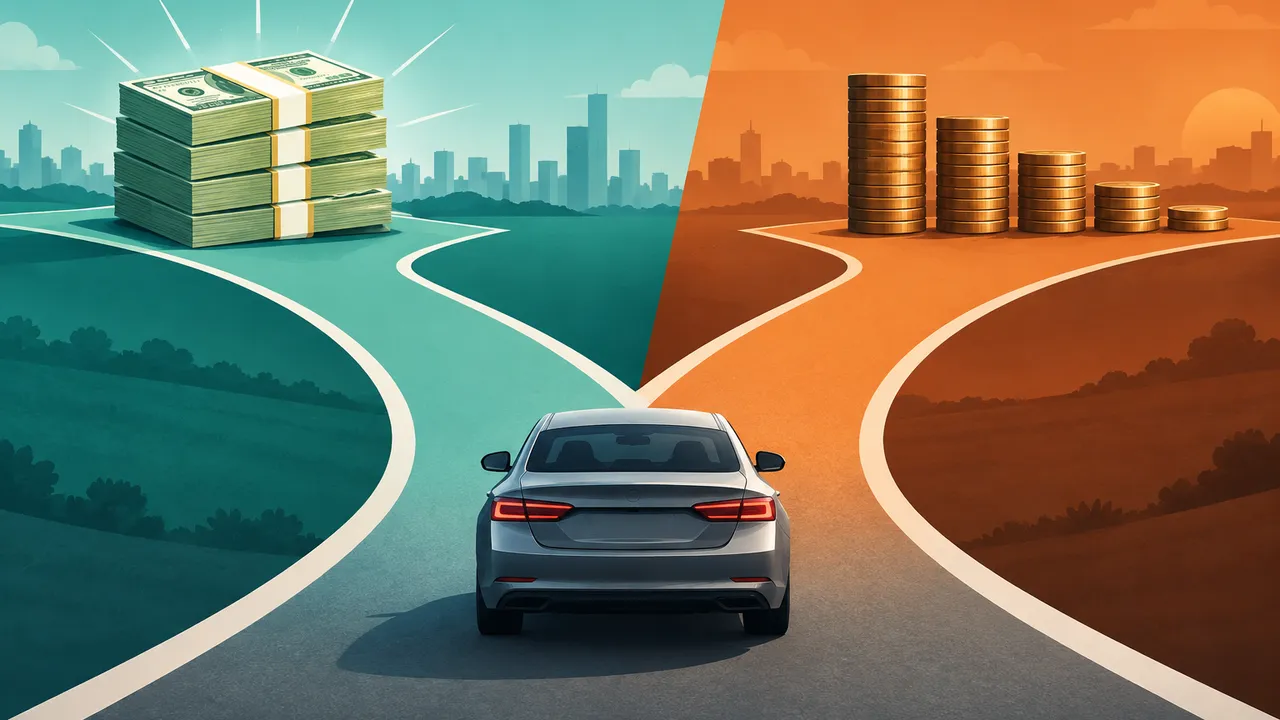
A manufacturer’s cash rebate can make a car look cheaper immediately. A promotional auto loan can save money quietly, through lower interest charges. When the offers cannot be combined, the winner depends on the rebate, both interest rates, the loan term and how long you actually keep the debt. Even a substantial rate discount can lose to upfront cash when you repay the loan within a year.
The comparison should start with the same negotiated vehicle price, down payment and repayment period—not whichever monthly payment a salesperson highlights. For an October 2026 purchase, verify current manufacturer offers before calculating: eligibility, participating vehicles and expiration dates can change, and an advertised rate is not an approval.
1. Put both offers on the same footing
Negotiate the selling price before applying either incentive, then request two itemized, written quotes. Keep the vehicle, equipment, trade-in allowance and optional products identical. Otherwise, a price increase or unwanted add-on can erase the apparent financing advantage. A trade-in payoff should also remain unchanged between quotes.
Use the same cash down payment in both calculations, applying the rebate against the purchase in its column. Include taxes, registration and dealer fees. State treatment of manufacturer rebates can affect taxable value, so equal selling prices do not always produce equal tax bills. Check your state revenue agency’s rules.
Ask whether the cash incentive requires financing through the manufacturer’s lending arm. If it does, pairing that rebate with a credit-union loan may not be permitted; obtain the qualifying lender and rate before comparing costs.
- Confirm the rebate and promotional APR are mutually exclusive.
- Check credit-tier, residency and vehicle eligibility requirements.
- Match loan lengths exactly; do not compare 60 months with 72.
- Separate conditional loyalty, military or graduate incentives.
2. Compare total dollars, not just the advertised rate
Consider an illustrative $35,000 vehicle with $5,000 down and a 60-month loan. One offer provides a $3,000 rebate with 6.9% financing; the other provides no rebate with 1.9% financing. These are hypothetical rates, not October market quotes. For clarity, the example excludes taxes and fees and assumes fixed-rate loans with no loan fees.
The rebate reduces borrowing to $27,000, but the higher rate generates about $5,000 in interest. Promotional financing requires borrowing $30,000 but costs about $1,470 in interest. Over five years, the low-APR offer wins by roughly $530. Figures below are rounded independently; multiplying a rounded monthly payment can produce a different total.
The promotional loan saves roughly $3,530 in interest but forfeits $3,000 in cash, leaving only the $530 net advantage. A required $600 product attached solely to that offer would therefore reverse the result.
| Measure | $3,000 rebate | Low-APR offer |
|---|---|---|
| Amount financed | $27,000 | $30,000 |
| APR | 6.9% | 1.9% |
| Approximate monthly payment | $533 | $525 |
| Total paid, including down payment | $37,000 | $36,470 |
3. Find the rebate’s break-even point
For a loan held to maturity, compare the down payment plus all scheduled loan payments and any charges paid separately. Do not subtract the rebate twice: once it lowers the amount financed, its benefit is already reflected in the payments. Likewise, avoid adding financed fees again as separate cash costs.
Run both quotes through an amortization calculator, then check the results against the lender’s federal Truth in Lending disclosures. Review APR, finance charge, amount financed and total of payments. The Consumer Financial Protection Bureau explains these terms and provides auto-loan shopping guidance.
With the example’s rates and term unchanged, the break-even rebate is approximately $3,450. Each additional rebate dollar also avoids interest at 6.9%, so closing the $530 gap requires less than $530 in extra cash.
- Get a bank or credit-union preapproval for the rebate option.
- Test the approved rate, not an advertised minimum.
- Change the rebate amount to find where totals become equal.
- Recalculate whenever the price or term changes.
4. Recalculate if you will pay off early
Early payoff can reverse the result because the rebate saves principal immediately, while a low rate delivers savings over time. In the example, paying off immediately after the 12th scheduled payment produces approximate total cash outlays of $33,720 with the rebate versus $35,520 with promotional financing. The rebate now wins by about $1,800, including the down payment in both totals.
That calculation assumes ordinary monthly amortization and no prepayment penalty or incentive recapture. Many auto loans accrue simple interest daily, so actual payoff quotes depend on dates. Compare down payment plus payments already made plus the remaining payoff balance—not the balance alone. Ask whether early payoff affects the rebate, and read the contract. Precomputed-interest loans may calculate early-payoff savings differently; do not assume every remaining finance charge disappears.
Selling or trading the car also triggers payoff. Use the same estimated resale value for both options and subtract sale proceeds from each total; any shortfall between proceeds and the payoff remains your responsibility.
5. Choose the deal that fits your actual plan
If you expect to make every scheduled payment, choose the lower full-term cost, provided the payment fits your budget. If you reliably expect to pay off early, compare both offers at that date. Test several timelines if a bonus, home sale or other expected cash source is uncertain.
Do not treat future refinancing as guaranteed savings. Approval, rates, fees and vehicle-value requirements can change. Verify the promotion on the manufacturer’s official offers site, then obtain the lender’s written terms and an itemized buyer’s order before signing. Resolve discrepancies before delivery, not afterward.
Before committing savings to early payoff, preserve cash for insurance deductibles and essential repairs. Paying off a 1.9% loan while carrying credit-card debt at 20% generally saves less interest than reducing the card balance first.
- Check offer expiration dates and participating dealers.
- Request payoff terms and any penalty in writing.
- Reject payment savings created only by extending repayment.
- Keep copies of incentive terms and signed disclosures.
Illustrations are not personalized financial advice; verify current eligibility, prices, taxes and loan terms with official manufacturer, lender and state agency sources.
AI Assistance Used — AI assistance was used in researching and drafting this article. It was reviewed, edited, and fact-checked by Jordan Singh before publication.