A Nail in Your Tire: When Repair Is Possible and When It Is Not
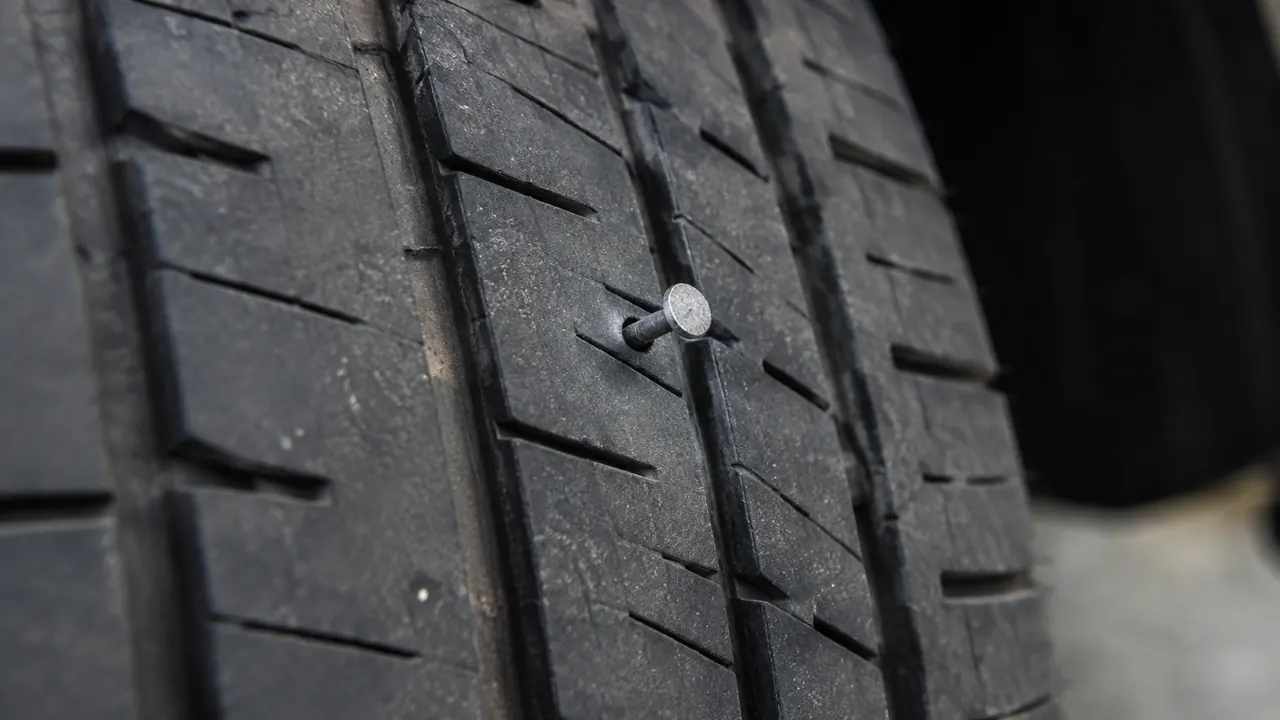
Finding a nail in your tire raises an immediate question: Can a shop fix it, or are you buying a replacement? The answer depends on more than whether the tire still holds air. A small puncture in the right part of the tread may qualify for repair, while a similar-looking hole near the sidewall may not. Damage hidden inside can also rule out a repair that initially looks straightforward.
For drivers in 2026, the important distinction remains unchanged: Stopping an air leak is not the same as restoring a tire to serviceable condition. A proper assessment considers puncture location, injury size, remaining tread, previous damage and how the tire was driven after losing pressure. It also requires removing the tire from the wheel, not simply looking at the nail from outside.
1. Start with safety, not with pulling out the nail
Leave the nail in place until you can assess the situation safely. It may be partly plugging its own hole, and pulling it out can turn a slow leak into a rapid one. If you notice the problem while driving, reduce speed smoothly and find a safe place to stop. Avoid abrupt braking or steering. A tire that looks reasonably round can still be substantially underinflated, so appearance alone is not enough.
Check pressure with a gauge if you can do so away from traffic. Use the vehicle manufacturer's cold inflation pressure on the driver's door placard or in the owner's manual, not the maximum pressure molded into the tire. If the tire is visibly flat, will not hold pressure, has a bulge or makes the vehicle handle abnormally, use a suitable spare or call roadside assistance. Repeatedly adding air is not a repair or proof that continued driving is safe.
- Do not work beside moving traffic; move yourself and passengers to a safer location.
- Check the spare's pressure and its speed and distance restrictions before using it.
- Tell the shop whether pressure dropped suddenly, gradually or more than once.
- If you cannot assess the tire safely, arrange assistance rather than experimenting.
2. Location determines whether repair is even an option
For ordinary passenger and light-truck tires, industry repair guidance limits puncture repairs to the designated tread repair area. A nail through the central tread is a potential candidate, not an automatic approval. Punctures in the shoulder, where the tread curves toward the sidewall, or in the sidewall itself are not candidates for a standard puncture repair. Those areas flex heavily, and a repair cannot reliably restore their structural integrity.
The boundary is not simply any spot that has a tread groove. A nail near an outer groove may be too close to the belt edge or shoulder, depending on the tire's construction. Nor does the visible entry point tell the whole story: An angled nail can enter an apparently acceptable area and travel into a nonrepairable zone. Have the technician identify the injury's full path and apply the tire manufacturer's limits. A promise to fix every nail hole without inspection is a reason to choose another shop.
| Puncture location | Likely assessment | Important qualification |
|---|---|---|
| Central tread repair area | Potentially repairable | Size, internal condition and manufacturer rules still apply |
| Near the outer tread edge | Requires careful boundary assessment | A visible tread groove does not establish eligibility |
| Shoulder | Not eligible for standard puncture repair | Replacement is generally required |
| Sidewall | Not eligible for standard puncture repair | Do not rely on an external plug |
3. The injury's size matters more than the nail's appearance
A commonly used U.S. industry limit for passenger and light-truck tire puncture repairs is a maximum injury diameter of 1/4 inch, or 6 millimeters. That is a limit on the actual damage, not the diameter of the nail head. The object may have moved, torn rubber or damaged cords as the tire rotated. Tire manufacturer policies can be more restrictive, so a hole below that general limit is not automatically repairable.
The shop needs to assess whether this is a simple puncture rather than a cut, tear or irregular injury. A long slit does not become acceptable because it is narrow. Multiple punctures require judgment, too: Repairs must not overlap, and manufacturer restrictions may limit their number or spacing. An earlier improper repair can also complicate or prevent an acceptable repair. Ask the technician to show you the damage after dismounting the tire instead of relying on the apparent size of the exposed nail.
- Ask for the measured injury size, not an estimate based on the nail head.
- Mention any previous plugs, patches or sealant used in this tire.
- Do not assume two nearby small holes qualify as two independent repairs.
4. Low-pressure driving can destroy an otherwise repairable tire
Air pressure helps a tire carry its load. When pressure falls, the sidewalls flex more than intended and heat builds up. Continued driving can damage the inner liner, cords and other structural components even if the nail made only a small, centrally located hole. Once that happens, sealing the puncture does not undo the damage. There is no universal safe number of miles to drive on an underinflated tire; speed, load, pressure loss and construction all matter.
That is why a technician should remove the tire and inspect inside for evidence such as abrasion, rubber debris, damaged cords or deterioration from heat and excessive flexing. Some damage is not apparent from the outside. Be candid about driving distance and whether the tire went completely flat. A tire-pressure monitoring system is useful, but its warning is not a guarantee that damage has just begun or that continued driving is safe. If you drove while the tire was badly underinflated, expect the shop to consider replacement even when the puncture itself meets normal repair criteria.
5. Overall condition and manufacturer rules can override the puncture
Repairability is also about the tire surrounding the hole. A tire worn to its treadwear indicators, typically corresponding to 2/32 inch of remaining tread, should be replaced rather than treated as a worthwhile repair candidate. Uneven wear, exposed cords, bulges, significant cracking, bead damage or signs of separation can independently disqualify it. Age matters, but there is no single replacement birthday that covers every tire and vehicle. Check both manufacturers' inspection and replacement guidance, using the tire's date code to establish its age.
Run-flat, self-sealing and acoustic-foam tires need particular attention to product-specific instructions. A run-flat tire's ability to travel after pressure loss does not guarantee that it can be repaired afterward. Some manufacturers restrict or prohibit repairs under particular conditions, and a shop may not have the procedures or materials needed for a specialized tire. Self-sealing technology may slow an air leak without resolving other damage. Ask the technician to check the exact tire model, not simply its size or the vehicle badge. If replacement is necessary, also verify matching requirements, especially on all-wheel-drive vehicles with limits on tire circumference differences.
6. A professional repair does more than stop escaping air
A proper puncture repair starts with removing the tire from the wheel and inspecting both the outside and inside. If the tire qualifies, the technician prepares the injury and uses an appropriate repair system that fills the puncture channel and seals the inner liner. This can be a combination patch-and-stem unit or an approved two-piece system. Selection and installation depend on the injury's angle and the repair material manufacturer's procedures; the same one-piece unit is not right for every puncture.
An outside-only string plug does not provide that internal inspection or inner-liner repair. A patch alone leaves the injury channel unfilled, potentially allowing moisture to reach reinforcing materials. Neither is the equivalent of the complete repair described in U.S. industry guidance. After the work, the shop should remount the tire, inflate it correctly and check for leaks, with balancing as needed. Ask what was found inside and what repair was installed. The invoice should make clear that you received a puncture repair, not merely a temporary leak-stopping service.
| Method | What it does | Key limitation |
|---|---|---|
| External string plug | Can slow or stop a leak | No internal inspection or inner-liner patch |
| Internal patch alone | Seals the inner liner | Does not fill the injury channel |
| Patch-and-stem or approved two-piece repair | Fills the channel and seals the liner | Only appropriate after inspection confirms eligibility |
| Roadside sealant | May temporarily contain an eligible leak | Not a substitute for professional inspection |
7. Treat roadside measures as a bridge to inspection
A vehicle-supplied sealant kit and compressor can sometimes help you reach service, but only within the kit's instructions. Such kits generally cannot address a sidewall injury, major tear or tire that has come off its bead. Check the sealant's expiration date and follow its pressure, speed and distance limits. If the specified pressure cannot be reached or maintained, stop and seek assistance. Do not substitute a generic mileage allowance for the instructions supplied with your vehicle or kit.
Tell the shop exactly what you used. Sealant may require cleanup and can complicate inspection or service, but it does not automatically make every tire unrepairable. Product compatibility and tire condition determine the next step. Before leaving after a repair or replacement, confirm the recommended inflation pressure and any follow-up instructions. If pressure falls again, have the assembly rechecked rather than assuming the nail was the only problem; valves and wheel leaks can also contribute. The practical rule is simple: Use roadside tools to manage an emergency, and let a dismounted inspection determine whether the tire belongs back on the road.
Consult a qualified tire professional and check current tire, vehicle and repair-product instructions before attempting a roadside measure or authorizing a repair.
AI Assistance Used — AI assistance was used in researching and drafting this article. It was reviewed, edited, and fact-checked by Jordan Singh before publication.