Portable vs. Upright Carpet Cleaners: Buy for Spots or Whole Rooms
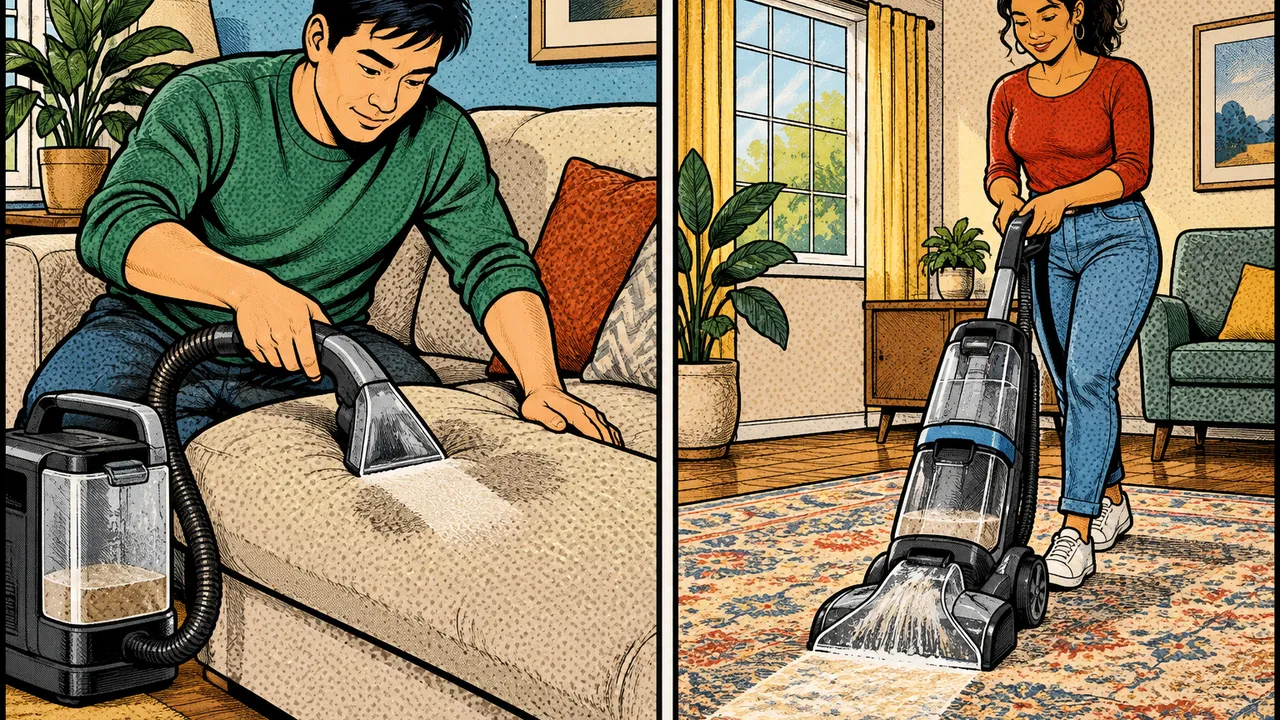
A spilled drink on a sofa and a dingy bedroom carpet call for different tools. Portable carpet cleaners concentrate spraying and extraction through a small hand tool. Upright carpet washers spread solution, agitate fibers and recover dirty water across a wider cleaning path. Neither replaces routine dry vacuuming, and both require access to water, a suitable drain and drying space.
The better purchase depends less on advertised power than on what needs cleaning, how often and where it can dry. As of October 2026, the distinction remains straightforward: buy a portable for targeted jobs and an upright for regular room-scale washing.
1. Match the machine to the workload
A portable extractor makes sense for tracked-in mud, isolated spills, carpeted stairs and compatible upholstery. Its small nozzle reaches places an upright floor head cannot, but cleaning a whole room means prolonged kneeling and overlapping hand passes. Portability also varies: a compact machine becomes noticeably heavier once its clean-water tank is filled.
An upright is the practical choice for broad carpeted areas and recurring traffic-lane cleaning. Some include hoses and upholstery tools, potentially covering both jobs. Check whether those accessories are included, how far the hose reaches and whether the entire machine must accompany you upstairs.
For stairs, measure hose reach from a stable landing rather than assuming the cleaner can balance on a tread. For sofas, check whether the supplied nozzle fits narrow seat panels and reaches behind fixed cushions.
- Choose portable for frequent small messes and limited storage.
- Choose upright for several carpeted rooms cleaned regularly.
- Consider renting for occasional whole-room work; compare local rental fees, solution costs and transport requirements before buying.
2. Check rugs and upholstery before buying
Neither format is automatically safe for every textile. Start with the carpet, rug or furniture maker’s cleaning instructions, then confirm that the machine and detergent are suitable. Water, brushing and prolonged dampness can affect dyes, backing and adhesives. Wool, silk, viscose, jute, antique rugs and delicate constructions may require specialist care.
Upholstery codes help screen choices: W generally permits water-based cleaning, S calls for solvent-based treatment, WS allows either category and X excludes liquid cleaners. However, W does not automatically authorize machine extraction or saturation. Check cushion-specific instructions, test an inconspicuous area and avoid soaking filling.
When testing an approved solution, use the specified dilution and blot with a white cloth to check for dye transfer. Let the test patch dry completely, then inspect for rings, texture changes or backing distortion.
- Confirm both fiber and backing compatibility, not just the visible pile.
- Keep powered brushes away from fringe; follow restrictions for loops.
- Protect flooring beneath rugs from moisture; do not assume backing is waterproof.
3. Judge recovery, not just advertised suction
Cleaning depends on solution delivery, agitation, nozzle contact and water recovery working together. Motor amperage and promotional suction claims do not establish how dry carpet will feel afterward. A portable’s concentrated nozzle can recover moisture effectively from a spot; an upright’s wider head covers more ground without necessarily outperforming it on upholstery.
Look for independent tests measuring stain removal and residual moisture under comparable conditions. The Carpet and Rug Institute’s official site lists equipment in its Seal of Approval program; check the exact model and listing scope. Manufacturer demonstrations are less useful when carpet type, detergent dose and drying conditions differ.
If recovery suddenly weakens, stop adding solution. Check tank seating, lid seals, the full-tank float and accessible nozzle blockages according to the manual. A poor seal or triggered shutoff can leave water behind despite a running motor.
| Factor | Portable extractor | Upright washer |
|---|---|---|
| Coverage | Localized passes | Broad passes |
| Agitation | Often manual scrubbing | Typically powered brushes |
| Recovery | Hand-tool contact matters | Floor-head contact matters |
| Reach | Usually hose-based | Attachments vary |
4. Budget for tank handling and cleanup
Tank capacity affects interruptions, but bigger is not always easier. Compare clean- and dirty-water capacities separately: the recovery tank may reach its shutoff level before the solution runs out. Check filled weight, carry-handle placement and whether tanks fit beneath your faucet. A manageable empty machine can become awkward on stairs.
Every wet-cleaning session creates another chore: cleaning the cleaner. Hair, grit and detergent residue collect in nozzles, brushes, hoses and recovery tanks. Removable parts and wide tank openings are valuable. Follow the manual for rinsing and drying; a self-cleaning cycle does not necessarily replace debris removal or tank washing.
Plan where dirty water will go: follow detergent labels and local wastewater rules, never using a storm drain. Remove collected hair and solids for the trash before emptying the tank into an appropriate sanitary drain.
- Check whether brush rolls and nozzle covers detach without tools.
- Look for accessible recovery-tank corners and removable strainers.
- Verify approved detergent, dilution instructions and replacement-part availability on the manufacturer’s site.
5. Plan drying before the first pass
Vacuum dry debris first, pretreat only as directed and avoid repeated wet passes. Use recovery-only passes if the machine supports them. Carpet may dry within several hours or remain damp into the next day, depending on pile, applied water, recovery, humidity and airflow. Neither machine type guarantees faster drying. Fans, air conditioning or a dehumidifier can help; open windows only when outdoor conditions support drying.
Clean rooms in stages so people and pets retain a dry route through the home. For approved washable rugs, check the underside and floor beneath; a dry-feeling pile does not establish that the backing is dry.
Keep traffic off damp carpet and follow furniture instructions before replacing cushions or furniture. EPA guidance emphasizes drying wet materials within 24–48 hours to help prevent mold; that is not a target waiting period or proof that saturated padding is safe. If carpet stays unusually wet, investigate promptly. For most spot-heavy households, portability wins; for routine whole-room maintenance, an upright saves substantial effort.
Specifications and care instructions can change; verify current manuals, warranties and certifications on manufacturers’ and certifiers’ official sites.
AI Assistance Used — AI assistance was used in researching and drafting this article. It was reviewed, edited, and fact-checked by Nadia Clarkson before publication.