Buying Glasses Online Versus Locally: Compare the Finished Pair
A low frame price tells you surprisingly little about what a pair of glasses will cost or how well it will work. The finished pair includes a prescription, a particular lens design and material, coatings, measurements and a frame that must stay in the right position on your face. A bargain can lose its appeal if the lenses are uncomfortable or the only fix requires another purchase.
For shoppers comparing options in March 2026, the useful question is not whether online or local sellers are universally better. It is which seller can deliver the right finished pair and resolve problems at an acceptable total cost. Online ordering can work well for straightforward needs and familiar fits. Hands-on service becomes especially valuable when small measurement or positioning errors have bigger consequences.
1. Price the complete pair on the same terms
Start with your current eyeglass prescription and the jobs these glasses need to do: everyday distance vision, reading, computer work or several distances. Then request an itemized total from each seller. An advertised frame price may exclude prescription lenses, while a package price may cover only a basic lens option. Neither figure is a fair comparison with a fully specified pair.
Match the lens category, material and coatings before comparing totals. Include shipping, taxes, optional warranties and any foreseeable adjustment charge. If using vision benefits, compare your actual out-of-pocket cost after the seller confirms eligibility. An out-of-network reimbursement is not necessarily the same as an immediate discount; verify documentation requirements and claim deadlines with your plan.
Also separate essential upgrades from preferences. A thinner lens may improve appearance or comfort, but the highest-priced material is not automatically necessary. Ask each seller why an upgrade suits your prescription and frame. Save the final configuration and written quote so a checkout change does not quietly turn your comparison into two different products.
| Quote item | What to match |
|---|---|
| Frame | Exact model and size, or a comparable fit and construction |
| Lenses | Single-vision, bifocal or progressive design; material |
| Treatments | Named coatings, tint and photochromic options |
| Service | Adjustments, troubleshooting, remake coverage and delivery |
2. Compare lens designs, not upgrade labels
Single-vision lenses generally correct one viewing distance; bifocals and progressives combine viewing zones. Within those categories, designs differ. Progressive lenses, in particular, can vary in their usable viewing areas and how the wearer moves between distances. Labels such as premium, digital or HD are not standardized guarantees that two retailers are selling equivalent lenses.
Material matters, too. Polycarbonate and Trivex are impact-resistant options often considered for children and active wearers, but ordinary glasses are not substitutes for appropriately rated protective eyewear. High-index materials can reduce thickness for some prescriptions. The benefit depends on prescription strength, frame size and shape, and where your eyes sit within the frame. Material also affects weight and optical characteristics.
Ask for the lens manufacturer and design name when available, plus the material or refractive index. If the seller uses a house label, ask what distinguishes its tiers. A smaller, well-centered frame may control thickness more effectively than buying a large frame and paying for a material upgrade. For multifocal wearers, describe your daily tasks rather than assuming the most expensive progressive is the best match.
3. Pay for coatings that solve a real problem
Anti-reflective treatment reduces reflections from lens surfaces and can be useful for nighttime viewing, video calls and everyday appearance. Scratch-resistant treatment helps protect lenses but does not make them scratchproof. Easy-clean surface treatments may simplify maintenance. Ask what comes standard and what the coating warranty actually covers, including whether a replacement carries a fee.
UV protection, polarization and photochromic performance are separate features. Polarized sunglasses can reduce reflected glare; they do not establish UV protection by themselves. Photochromic lenses change with light conditions, but performance varies by product and temperature. Many darken less behind a car windshield, so drivers should verify the specific product's behavior. Do not assume a clear blue-light-filtering upgrade is necessary for routine screen use; evidence does not clearly support these lenses for relieving digital eye strain.
- Confirm the stated UV protection rather than relying on lens darkness or color.
- Ask whether anti-reflective treatment is included on the exact lenses you selected.
- Check coating exclusions for scratches, heat damage, peeling and cleaning products.
- For screen discomfort, discuss working distance, prescription accuracy, breaks and dry-eye symptoms with an eye care professional.
4. Treat measurements as part of the product
Your prescription specifies optical correction, but it does not necessarily contain every measurement needed to make your chosen glasses. Pupillary distance, or PD, helps position lenses horizontally. Monocular PD records each eye separately and can account for asymmetry that a single total does not show. Depending on the lens design, fitting height and other measurements may also be needed.
Progressive fitting height depends on where each pupil sits in the selected frame after that frame is adjusted. Some customized lenses also use measurements related to frame tilt, curvature and distance from the eye. Copying numbers from an old pair may not work when the new frame sits differently. A frame that slides changes the relationship between your eyes and the lenses.
Phone-based measuring tools and virtual try-on can be useful shopping aids, but appearance previews do not establish a comfortable bridge fit or accurate lens placement. Follow the seller's measurement process carefully and ask how questionable results are checked. In the United States, federal rules generally require release of your eyeglass prescription after a refractive exam, but do not generally require PD to appear on it; state requirements can differ.
- Ask which measurements your specific lens design requires and who takes responsibility for them.
- Check whether fitting height is measured in your selected, adjusted frame or estimated.
- If measurements disagree, resolve the discrepancy before placing the order rather than averaging them.
5. Put frame fit and follow-up service on the checklist
Frame dimensions are helpful starting points, not a fit guarantee. Two frames with similar lens width, bridge width and temple length can sit differently because of bridge shape, weight distribution and construction. Look for stable placement without pinching, lashes touching the lenses or temples pressing behind the ears. Your eyes should sit appropriately within the frame for the planned lenses.
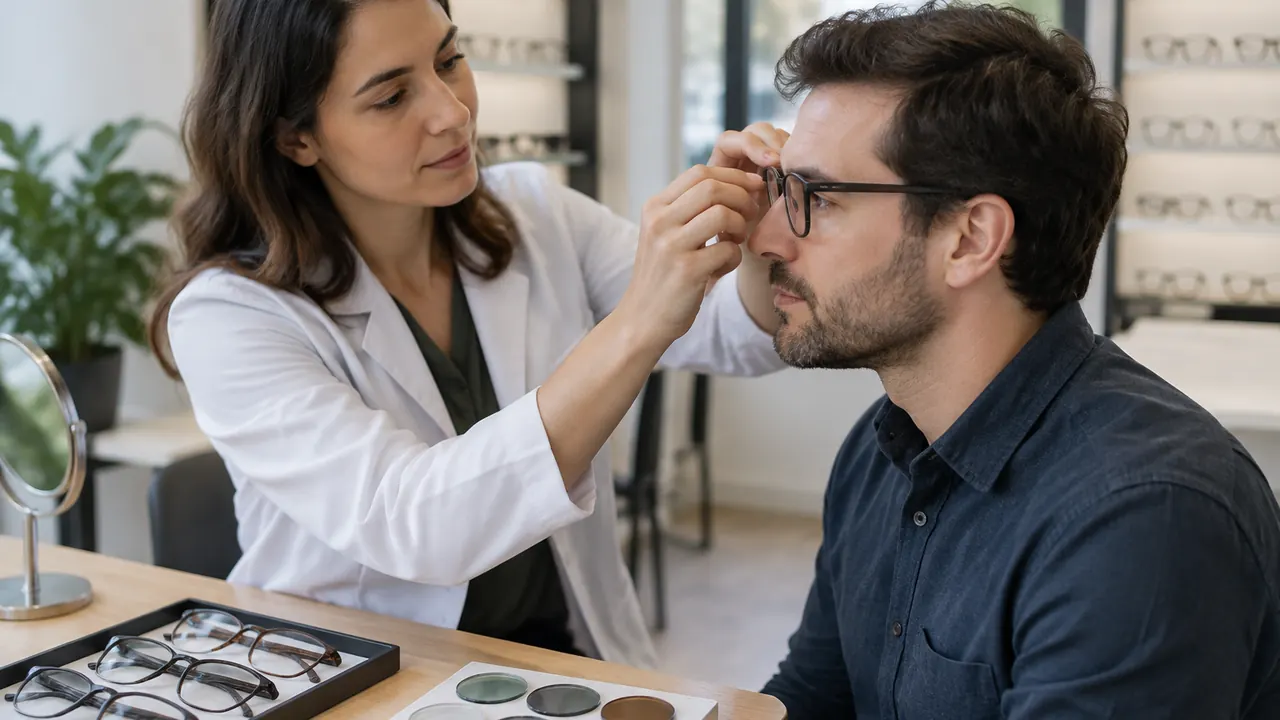
A local fitting lets an optician assess the frame on your face and adjust compatible parts before measurements are finalized. Online home try-on can help narrow choices, but sample frames may feel different after prescription lenses add weight. Ask whether the delivered frame can be adjusted locally and whether the seller reimburses that service.
Do not assume a nearby shop will adjust another retailer's glasses for free or accept the risk of working on fragile materials. Call first. A seller's local partners may offer only limited services, while a storefront may outsource lens production. The important distinction is accountable support, not simply where the order was entered.
| Service question | Why it matters |
|---|---|
| Who adjusts the finished frame? | Stable positioning affects comfort and vision. |
| Who checks lens accuracy? | Troubleshooting should distinguish lens issues from fit issues. |
| Is follow-up included? | Repeat visits or outside fees change the total cost. |
| Who handles a remake? | One accountable contact can simplify a disputed problem. |
6. Read remake terms before you need them
Returns, adaptation guarantees, prescription-change coverage and defect warranties are different promises. A return policy might provide store credit instead of a refund. A progressive adaptation guarantee might allow a different lens design, or replacement with another lens type, rather than money back. Find out when the clock starts: order date, shipment or delivery.
Ask what happens if the prescription is correct but the glasses still do not work. Troubleshooting may require checking the manufactured lenses, frame alignment and fitting measurements, followed by a prescription recheck when appropriate. Responsibility can become complicated when one provider writes the prescription and another makes the glasses. Clear written policies are more useful than a general satisfaction claim.
- Confirm the deadline for reporting problems and whether troubleshooting pauses that deadline.
- Ask how many remakes are allowed and which changes qualify.
- Check return shipping, restocking charges and whether lens upgrades are refundable.
- Verify coverage for measurement errors, prescription changes and accidental damage separately.
- Keep your prescription, order details, receipts and messages until the pair is working reliably.
7. Choose hands-on help when the margin for error narrows
Online ordering may be a reasonable choice for a stable, straightforward single-vision prescription, particularly when you know the frame fit and have reliable measurements. A backup pair can be a lower-stakes test, provided it meets your needs. Local service is not automatically superior, though; ask the same detailed questions about lenses and policies.
Hands-on care is especially useful for strong prescriptions, significant astigmatism, prism, substantial differences between the eyes, first-time progressives or previous adaptation problems. These situations are not universal prohibitions on online ordering. They increase the value of precise measurements, appropriate frame selection and someone who can inspect the finished pair while you wear it. Children and people with facial asymmetry or persistent slipping may also benefit from in-person fitting.
After delivery, check comfort and vision at the distances the glasses were designed for. Some adjustment can be expected with a changed prescription or lens design, but do not assume persistent blur, double vision or headaches must simply be endured. Contact the dispensing seller promptly and involve your eye care professional as needed. The better purchase is the pair that works, with a practical path to correction if it does not.
Before ordering, verify current prices, benefits and written return or remake terms, and consult an eye care professional about prescription or fitting concerns.
AI Assistance Used — AI assistance was used in researching and drafting this article. It was reviewed, edited, and fact-checked by Lisa Barber before publication.