Home Sleep Apnea Test or Sleep Lab: Which Do You Need?
A sleep apnea test should answer a medical question, not just fit your schedule. If you snore loudly, wake up gasping or feel exhausted despite enough time in bed, testing can help determine whether breathing repeatedly stops or becomes shallow during sleep. For some adults, a home sleep apnea test is a sensible first step. Others need the broader measurements and overnight supervision of a sleep laboratory.
In 2026, mail-order testing, telehealth visits and wearable sleep features make the options look more interchangeable than they are. A clinician-ordered home test is not the same as a smartwatch alert, and neither measures everything a laboratory study can. The right choice depends on your symptoms, medical history and the question being investigated. Comfort and cost matter, but so does having a plan if the first test does not explain your symptoms.
1. What each test actually measures
An in-lab overnight sleep study, called polysomnography, records brain waves, eye movements and muscle activity to identify sleep and its stages. It also typically measures airflow, breathing effort, oxygen levels, heart rhythm and leg movements. Staff watch the signals and can correct a loose sensor. These measurements help distinguish obstructive apnea, in which the airway closes, from central apnea, in which breathing effort pauses, and evaluate other sleep problems.
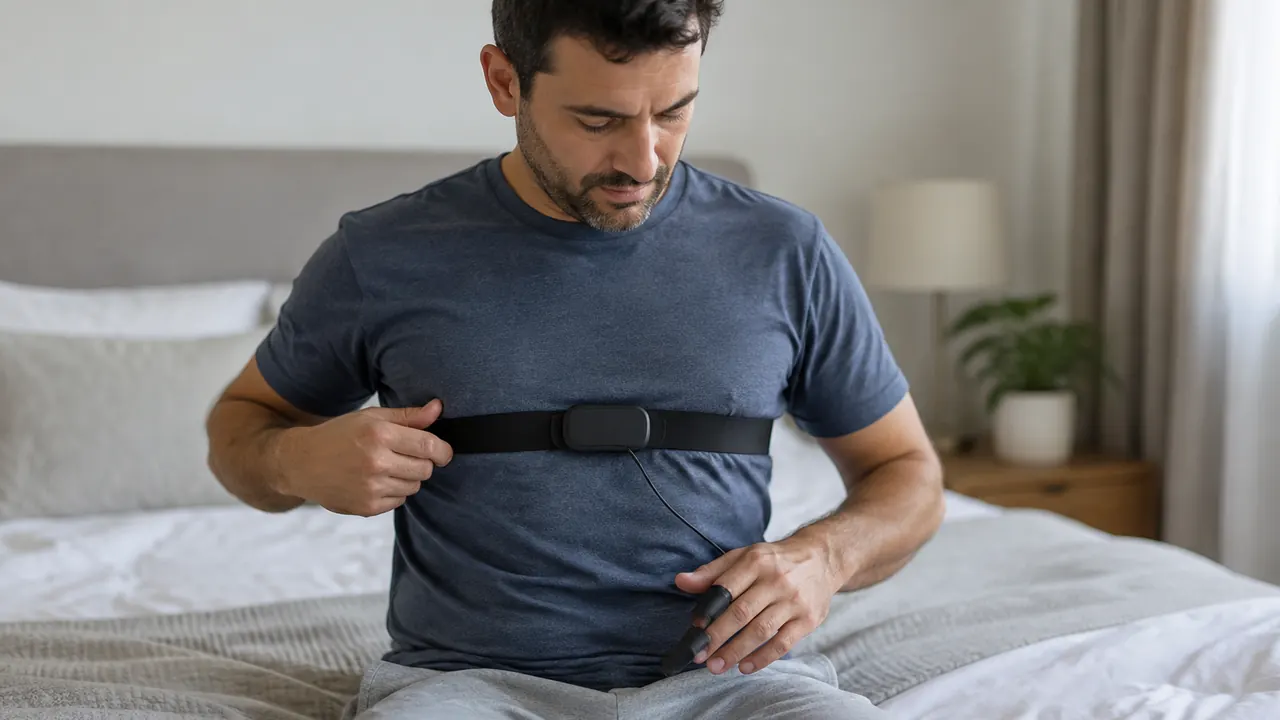
Most home sleep apnea tests collect fewer signals. Common systems use a nasal airflow sensor, chest or abdominal belts and a finger oxygen sensor. Other systems use peripheral arterial tone and additional signals to estimate breathing disturbances. Devices differ, so ask what yours records. Most do not directly measure brain waves or identify brief brain-wave arousals. That makes home testing a focused tool for suspected obstructive sleep apnea, not a comprehensive investigation of poor sleep.
| Feature | Home sleep apnea test | In-lab polysomnography |
|---|---|---|
| Sleep stages | Usually not directly measured | Measured using brain waves and other signals |
| Breathing and oxygen | Recorded; sensors vary by device | Recorded with multiple channels |
| Overnight help | Usually no real-time technician | Technician monitors signals |
| Other sleep disorders | Limited assessment | Broader assessment; some conditions need additional testing |
2. When home testing is a reasonable first choice
Home testing works best for medically uncomplicated adults whose symptoms and evaluation suggest an increased likelihood of moderate to severe obstructive sleep apnea. A clinician should review your history before ordering it, rather than relying only on a questionnaire or a device's automatic score. Loud habitual snoring, witnessed breathing pauses and daytime sleepiness are important clues, but no single symptom confirms the diagnosis.
The practical advantage is straightforward: You sleep in your own bed, usually with fewer wires and no overnight trip. That may help if unfamiliar surroundings keep you awake. However, you must position the equipment correctly and keep it attached. Limited hand mobility, difficulty understanding instructions or an inability to get help can make an attended test more reliable. Home testing is generally not recommended to diagnose obstructive sleep apnea in children; pediatric evaluation follows different pathways.
- Ask whether your symptoms and medical history make you an appropriate home-testing candidate.
- Confirm who will explain setup, troubleshoot problems and interpret the recording.
- Find out how quickly you must return reusable equipment and whether late fees apply.
- Arrange a follow-up visit before testing so the result leads to a treatment or evaluation plan.
3. Who may need a sleep laboratory instead
Laboratory testing is generally preferred when there is significant heart or lung disease, possible breathing-muscle weakness from a neuromuscular condition, awake hypoventilation or concern for sleep-related hypoventilation. Chronic opioid use, a history of stroke and severe insomnia also favor polysomnography. These situations can make a limited home recording harder to interpret or raise concerns beyond straightforward airway obstruction. Not every stable medical condition automatically rules out home testing; the details matter.
A lab may also be needed when symptoms suggest another sleep disorder, such as unusual nighttime behaviors or movements, or when a clinician suspects central sleep apnea. For possible narcolepsy, evaluation may include an overnight study followed by a separate daytime sleep-latency test. Tell the sleep clinician about medications, oxygen use and any known heart, lung or neurologic conditions. Depending on the question, the laboratory may need specialized measurements, such as carbon dioxide monitoring, that are not included in every standard study.
- Ask whether the concern is obstruction, central apnea, low ventilation or more than one problem.
- Describe insomnia and nighttime behaviors, not just snoring and daytime fatigue.
- Check that the ordered study includes any extra monitoring your clinician considers necessary.
4. Why a negative home result may not settle it
Most home tests cannot precisely separate time asleep from time awake. Their respiratory event index, or REI, often divides breathing events by monitoring time rather than actual sleep time. A laboratory's apnea-hypopnea index, or AHI, uses measured sleep time. If you lie awake for substantial periods during a home recording, that larger denominator can make breathing disturbances look less frequent than they really are during sleep.
Home testing can also miss events associated with brief arousals rather than clear oxygen drops. Sensors can shift, and apnea varies from night to night with sleep position, REM sleep and other factors. A night with little back-sleeping or REM sleep may not reflect your usual burden. The report therefore needs interpretation alongside symptoms and recording quality, not just a number labeled normal.
For an adult being evaluated for suspected obstructive sleep apnea, a single negative, inconclusive or technically inadequate home test should generally be followed by polysomnography. Simply repeating a home test is not the standard recommended next step. If symptoms remain concerning after a negative lab study, a clinician may consider another polysomnogram. Persistent sleepiness also deserves evaluation for other causes; it should not be dismissed because one recording was negative.
5. Compare the full cost, not just the advertised price
Home testing usually costs less because it does not require an overnight room and onsite staffing. Cash prices commonly run in the hundreds of dollars, while laboratory charges can reach several thousand dollars. Those are broad guideposts, not quotes: Location, facility, study type, interpretation fees and insurance contracts can change the total substantially. A hospital's listed charge may differ sharply from its negotiated or self-pay price.
Before booking, request a written estimate for your specific order. Ask your insurer about medical-necessity rules, prior authorization, network status and whether home testing must come first. An authorization is not a guarantee of payment. A low advertised home-test price may exclude the consultation, interpretation or follow-up; a failed or negative test may add the cost of a laboratory study. Conversely, choosing a lab without meeting coverage requirements can leave you with an avoidable bill.
- Get the proposed billing codes and share them with your insurer.
- Ask whether the interpreting clinician and testing facility are both in network.
- Compare your estimated out-of-pocket insurance cost with any available self-pay package.
| Cost question | What to verify |
|---|---|
| What is included? | Equipment, shipping, clinician review and follow-up |
| Who bills? | Facility, testing company and interpreting clinician |
| What will insurance pay? | Network rules, authorization, deductible and coinsurance |
| What if testing fails? | Repeat-testing policy and possible laboratory costs |
6. What the night feels like—and how to prepare
At home, you typically apply the sensors near bedtime, start the recorder and remove everything in the morning. Follow the provider's instructions rather than improvising sensor placement. Ask for a demonstration or video beforehand, and check whether telephone support is available. Some devices are returned for downloading; others transmit data or use disposable components. Make sure you understand the process before bedtime, especially if testing is scheduled for only one night.
In a laboratory, a technologist attaches sensors to your scalp, face and body; adhesive, wires and a nasal sensor can feel unfamiliar. Most laboratories provide a private sleeping room, though arrangements vary. You can generally change position and request help getting up to use the bathroom. Ask about accessibility, caregiver arrangements and your usual sleep schedule. For either test, follow instructions about naps, caffeine and alcohol, and do not stop prescribed medicines or take a new sleep aid unless the ordering clinician directs it.
7. Make sure the result answers your next question
An abnormal result is the beginning of a treatment discussion, not just a score to file away. Ask about apnea severity, oxygen findings, recording quality and whether the pattern fits your symptoms. Adult AHI categories commonly use 5 to under 15 events per hour for mild apnea, 15 to under 30 for moderate apnea and 30 or more for severe apnea. Diagnosis and treatment decisions also depend on symptoms, associated conditions and how events were scored.
Some laboratory visits can become split-night studies: If enough apnea is documented early, staff may use the remaining time to adjust positive airway pressure. That is not guaranteed and requires sufficient testing time and appropriate criteria. Whether you start with home testing or a lab, leave with a clear next step: treatment, additional testing or evaluation for another cause. If you are struggling to stay awake while driving, do not wait for a test result to take precautions. Avoid driving while sleepy and contact your clinician promptly.
Testing decisions should be made with a qualified clinician; verify current device services, prices and insurance requirements before scheduling.
AI Assistance Used — AI assistance was used in researching and drafting this article. It was reviewed, edited, and fact-checked by Jordan Singh before publication.