Home EV Charging: What to Check Before Buying a Charger
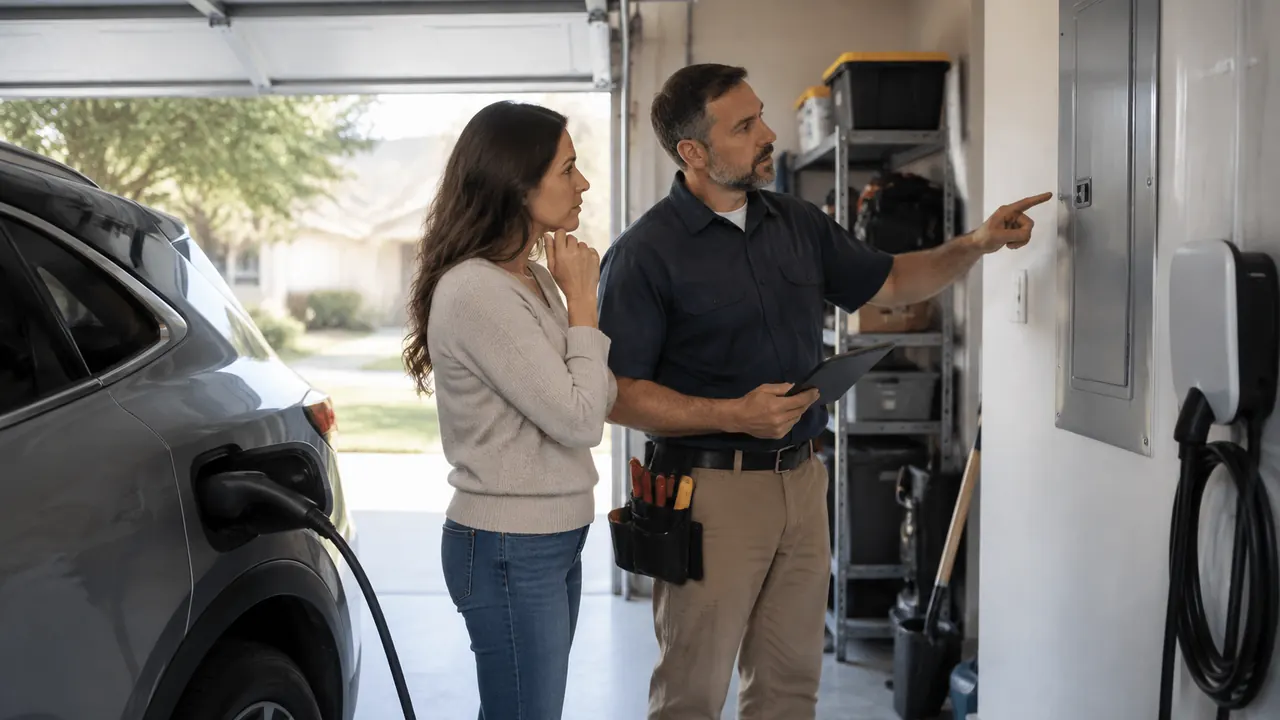
Buying a home EV charger is often the easy part. The harder questions are whether you can legally reach your parking space with a cable, how much energy you need overnight and what your electrical system can safely supply. A charger advertised as powerful or inexpensive may be a poor fit if it requires extensive wiring, misses a utility incentive or supplies more power than your car can accept.
For shoppers in July 2026, the sensible starting point is a site assessment, not a product ranking. Some drivers can cover modest daily mileage with a suitable existing 120-volt outlet and an approved charging cord. Others should get quotes for a dedicated 240-volt charging circuit. Neither answer follows automatically from owning an EV, and neither should depend on guesswork about an outlet or a breaker.
1. Confirm that your parking space can support charging
Start where the car actually sits overnight. A private garage or driveway usually presents fewer complications than an assigned apartment space, shared parking lot or curbside spot. Check whether the cable can reach the vehicle’s charging port without crossing a sidewalk, blocking an exit or creating a trip hazard. Consider where a second vehicle parks and how snow, standing water or a garage door could affect the equipment.
Renters and condominium owners should secure the necessary written approvals before ordering hardware. State right-to-charge laws may limit an owner’s or association’s ability to refuse some installations, but they do not necessarily eliminate applications, insurance requirements or installation costs. In shared parking, establish who owns the equipment, pays for electricity and maintains it. An informal promise of access is not a dependable long-term charging plan.
- Measure the cable route to the charging port, not just the distance to the bumper.
- Confirm that outdoor equipment and its mounting location suit the expected weather exposure.
- Ask whether trenching, wall penetrations, parking rules or historic-district restrictions require additional approval.
- For shared installations, settle billing, access control and what happens when you move.
2. Estimate the energy you need between trips
Base your decision on ordinary driving, not the battery’s full capacity. If you drive 30 miles a day and the car averages 3 miles per kilowatt-hour, that driving uses about 10 kWh from the battery. The electricity drawn from the wall will be higher because charging has losses; cold weather and cabin or battery conditioning can increase demand. Use your vehicle’s actual consumption when available rather than assuming every EV performs alike.
Then consider the hours you are parked and able to charge. Replacing a modest daily energy use over 12 hours is different from recovering a long commute during a five-hour cheap-rate window. Allow some margin for errands and winter conditions, but do not assume you must recharge an empty battery every night. Occasional fast charging away from home may be cheaper than building a home system around your rare longest day.
These are illustrative power levels, not guaranteed charging speeds. Actual output depends on voltage, equipment settings and vehicle limits. Larger vehicles generally add fewer miles per hour at the same power.
| Typical setup | Approximate input power | Main consideration |
|---|---|---|
| 120 volts, 12 amps | 1.4 kW | May cover modest mileage with long parking periods |
| 240 volts, 16 amps | 3.8 kW | Useful step up without high charging current |
| 240 volts, 32 amps | 7.7 kW | Often sufficient for routine overnight replenishment |
| 240 volts, 48 amps | 11.5 kW | Requires supporting wiring and vehicle capability |
3. Decide whether an existing outlet is genuinely suitable
Level 1 charging uses a standard 120-volt supply, but an outlet being nearby does not establish that it is safe for sustained charging. Have a qualified electrician assess its condition, grounding, wiring, circuit protection and other loads. A worn receptacle, loose connection or heavily shared circuit can make an otherwise modest charging load unsafe. Follow both the vehicle and charging equipment instructions, including any dedicated-circuit requirement.
An existing suitable outlet may meet your needs if the car spends enough time parked and routinely replaces the energy you use. Try the approved setup under realistic conditions before assuming you need faster equipment. A week of short summer trips, however, does not establish that the same arrangement will cover a winter commute. Keep track of overnight energy added and whether the battery level is gradually falling.
Do not use ordinary extension cords, power strips or improvised outlet adapters for EV charging. Stop using equipment with damaged parts, a loose plug, scorching, a burning smell or unusual heat, and arrange an inspection. An existing 240-volt dryer or range receptacle is not automatically a ready-made charging solution either; its circuit, location, receptacle and any proposed load-sharing equipment need evaluation.
4. Have electrical capacity checked before choosing amperage
A panel with empty breaker spaces does not necessarily have spare electrical capacity. An electrician should evaluate the service, panel, feeder and expected loads using a calculation accepted by the local authority. Electric heating, water heating, cooking and other major equipment matter. Older wiring or unsuitable panel equipment may create additional work, independent of how much charging power you want.
EV charging is generally treated as a continuous load. Under common residential sizing rules, 32-amp charging needs a 40-amp circuit, while 48-amp charging needs a 60-amp circuit. Wiring methods, terminal ratings, manufacturer instructions and locally adopted code still govern the installation. Do not increase a breaker size or a charger’s current setting without professional verification that the entire circuit supports it.
Ask about a lower charging setting or an approved energy-management system before accepting a service upgrade as unavoidable. Suitable load management can reduce charging when household demand rises, but it must be designed and installed for that purpose. Get dedicated-circuit quotes if daily energy needs exceed safe Level 1 replenishment, the existing circuit is unsuitable or a shorter charging window matters. Compare usable overnight energy, not simply the highest amperage on the box.
5. Match the equipment to the car and installation
The wall-mounted product commonly called a charger is usually EV supply equipment, or EVSE; the car’s onboard charger converts AC power for the battery. Both have limits. Buying a higher-output unit will not make a car exceed its AC charging capability, although appropriately planned wiring may help accommodate a future vehicle.
In 2026, U.S. buyers will encounter both J1772 and NACS, standardized as SAE J3400, on AC charging equipment and vehicles. Confirm the connector on your exact vehicle and whether any adapter is approved for that vehicle, charging equipment and type of charging. AC and DC adapters are not interchangeable merely because a listing uses a familiar connector name. Also compare hardwired and plug-in options: hardwiring eliminates a receptacle connection, while plug-in equipment requires a properly specified outlet and applicable protection.
- Look for a safety certification from a nationally recognized testing laboratory, such as UL or ETL.
- Check cable length, outdoor rating, operating temperature range and accessible mounting options.
- Verify whether basic charging works without Wi-Fi, an app account or a paid subscription.
- Ask about warranty service, replacement cables and how current limits are secured during installation.
6. Price the electricity and verify incentive deadlines
A low overnight rate can change the economics, but read the complete tariff. Some time-of-use plans apply to the whole home, so cheaper charging may come with more expensive afternoon air-conditioning or cooking. Other programs require approved equipment, vehicle connectivity, separate metering or permission for managed charging. Compare the expected annual household bill, including fixed charges, rather than focusing on one attractive cents-per-kWh figure.
Calculate charging costs using energy drawn from the wall. For example, 300 kWh at 15 cents per kWh costs $45 before any additional applicable charges. Your actual use and marginal rate may differ substantially. If the low-price window is short, check whether your proposed equipment can replenish your normal daily use within it. Coordinate vehicle and charger schedules so conflicting settings do not prevent charging.
- Check utility, state and local programs before purchasing; some require advance approval or specific installers.
- For July 2026 projects, note that the federal Section 30C credit ended for property placed in service after June 30, 2026.
- Verify current eligibility, available funding and installation deadlines directly; an old rebate page or sales estimate is not approval.
7. Get comparable installation quotes and close out the work
Seek written quotes from appropriately licensed and insured electrical contractors experienced with EV charging. Give each the same parking location, target charging current and information about planned electrical additions. Installation costs depend heavily on routing, distance, trenching, wall repairs and service work, so an equipment-only price says little about the finished project.
Require an itemized scope covering the circuit, wiring route, equipment mounting, permits, inspection and any utility coordination. Ask who handles patching and whether the quoted price includes taxes and required protective devices. Local permit and inspection rules vary; buying listed equipment does not replace them. If one contractor recommends a service upgrade and another proposes load management, ask each to explain the calculation and approval path.
Before final payment, obtain the inspection signoff where required and have the installer demonstrate charging, cable storage and safe shutdown. Confirm the commissioned current limit matches the circuit and record the equipment model, warranty and permit information. A good installation is not simply one that starts charging on delivery day. It is one that safely meets your routine needs at a cost you understand.
Verify current utility rates, incentive terms and local requirements, and have a qualified electrical professional assess your proposed charging installation.
AI Assistance Used — AI assistance was used in researching and drafting this article. It was reviewed, edited, and fact-checked by Nadia Clarkson before publication.