Is a Heat Pump Dryer Right for You? Check Cycle Times, Power and Maintenance
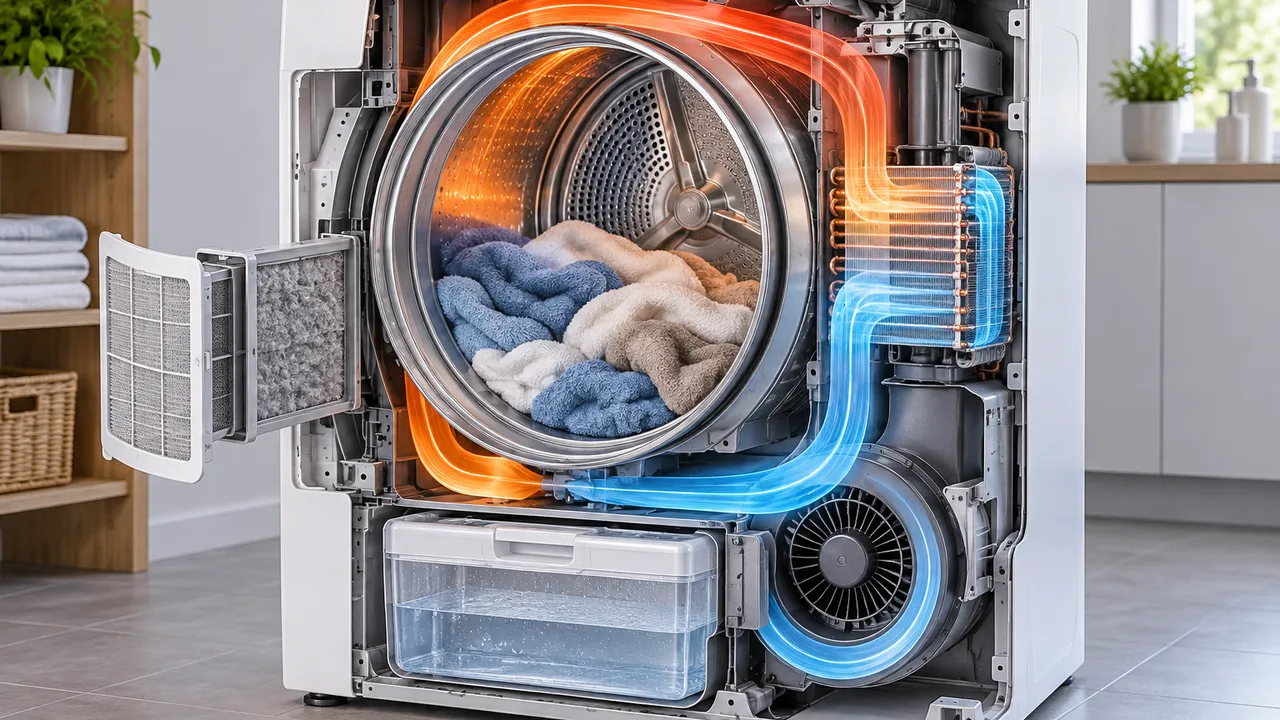
A heat pump dryer can solve a difficult laundry-room problem: drying clothes without sending hot, moist air through an exterior vent. It can also use substantially less electricity than a conventional electric dryer. The trade-off is not simply a higher purchase price. Drying speed, installation requirements and cleaning routines deserve equal attention. Start with your busiest laundry day: count loads, identify bulky items and measure the available installation space.
For US shoppers comparing models in October 2026, the key is to evaluate the exact appliance, not the category’s reputation. Some heat pump dryers connect to standard household outlets; others require a dedicated higher-voltage circuit. Some collect water in a tank, while others need a drain connection.
1. Understand what ventless drying actually changes
A conventional vented dryer heats air, passes it through tumbling clothes and exhausts moisture outdoors. A heat pump dryer recirculates air through a refrigeration system: one heat exchanger removes moisture as liquid water, while another reheats the air. This recovers heat instead of repeatedly throwing it outside.
Ventless does not automatically mean heat pump. Other condensing dryers use resistance heating and can consume considerably more electricity. Check the manufacturer’s specifications and look for heat pump technology explicitly. Efficiency comparisons should involve similar capacities and test conditions; a compact appliance is not a substitute for a larger one if it doubles your loads.
A vented dryer also expels conditioned indoor air, which replacement air from outdoors must offset. Eliminating that exhaust can reduce heating or cooling demand, although the benefit varies with climate and house construction.
- No exterior exhaust duct is needed.
- Lower drying temperatures can be gentler on fabrics.
- Condensed water still needs collection or drainage.
- The appliance still releases some heat into the room.
2. Judge cycle times against your laundry routine
Heat pump cycles often run longer than conventional vented cycles, particularly on efficiency-focused settings. Roughly one to three hours is a useful planning range for many loads, not a promise; bulky items or unfavorable conditions can push beyond it. Faster models exist, so compare the specific cycle, load size and dryness setting behind any advertised time.
The practical question is whether drying keeps pace with washing. A household running consecutive loads may notice delays that an overnight laundry user would not. Also distinguish standalone dryers from washer-dryer combinations: their advertised wash-and-dry time includes two jobs, and drying capacity may differ from washing capacity.
Use the washer’s highest spin speed permitted by the fabric care instructions. Removing more water mechanically reduces the dryer’s workload; untangling sheets before transfer also helps expose wet surfaces to circulating air.
| Load or setting | Likely effect | Check before buying |
|---|---|---|
| Small, well-spun load | Shorter drying | Minimum recommended load |
| Towels or heavy cotton | Longer drying | Rated drying capacity |
| Bulky bedding | Uneven drying possible | Bedding instructions |
| Quick or boost mode | Potentially faster | Energy and fabric restrictions |
3. Match the electrical supply, not just the plug
US heat pump dryers are available with different electrical requirements, including 120-volt and 208/240-volt configurations. Neither the technology nor cabinet size tells you which outlet is needed. A conventional electric dryer commonly uses a dedicated 240-volt circuit; a gas dryer’s nearby 120-volt outlet is not automatically suitable for a replacement heat pump model.
Before ordering, download the installation manual for the exact US model number. Confirm voltage, amperage, circuit requirements, grounding and whether a cord is included. A familiar-looking outlet does not establish compliance. Have a qualified electrician assess changes, and do not plan around extension cords, improvised adapters or sharing a circuit unless expressly permitted.
Do not confuse rated power in watts with energy per load in kilowatt-hours. A lower-power dryer running longer may still save energy, but voltage alone cannot establish efficiency or drying speed.
- Confirm the required receptacle and plug configuration.
- Check breaker size and dedicated-circuit instructions.
- Include electrical work in the installed price.
4. Plan drainage and the surrounding room
Water handling varies by model. Some dryers offer a removable condensate reservoir, some support a direct drain hose, and some require a drain connection. A reservoir avoids permanent plumbing but adds an emptying task. Direct drainage is convenient only if the hose route, connection and drain height meet the manual’s limits.
Ventless also does not mean suitable for any enclosed space. Manufacturers specify operating temperatures, clearances and sometimes closet ventilation openings. Cold garages, hot utility rooms and cramped closets can reduce performance or fall outside approved conditions. Check door swing, service access and stacking compatibility rather than relying on cabinet dimensions alone.
If choosing a reservoir, check its location and whether you can comfortably remove it when full. Stacking can put an upper tank beyond easy reach, making direct drainage more practical.
- Verify whether the drain kit is included.
- Check pump lift and hose-routing limits.
- Keep required air openings and clearances unobstructed.
- Use only an approved stacking kit.
5. Price the savings alongside the cleaning commitment
Expect to clean the primary lint filter after each load. Depending on the design, additional fine filters, foam elements or accessible heat-exchanger areas may need periodic attention. Follow the manual’s cleaning methods and intervals; some components are washable, while others are not. A self-cleaning condenser claim does not mean the entire dryer is maintenance-free.
Compare purchase price, installation, electricity consumption and service availability. ENERGY STAR’s product directory, federal energy guidance and manufacturer documentation can help evaluate efficiency claims. Actual savings depend on local rates, load frequency and the dryer being replaced; replacing gas changes the calculation. A heat pump model makes the strongest case when its installation flexibility and energy savings outweigh slower throughput and extra upkeep.
For a simple payback estimate, divide the extra installed cost by expected annual operating savings. A $600 premium with $100 yearly savings takes six years to recover, excluding financing, repairs and rate changes.
Verify current specifications, prices, rebates and installation requirements through manufacturer documentation, utility programs and relevant government sources before purchasing.
AI Assistance Used — AI assistance was used in researching and drafting this article. It was reviewed, edited, and fact-checked by Jordan Singh before publication.