Chest vs. Upright Freezers: What Matters When You Keep One in the Garage
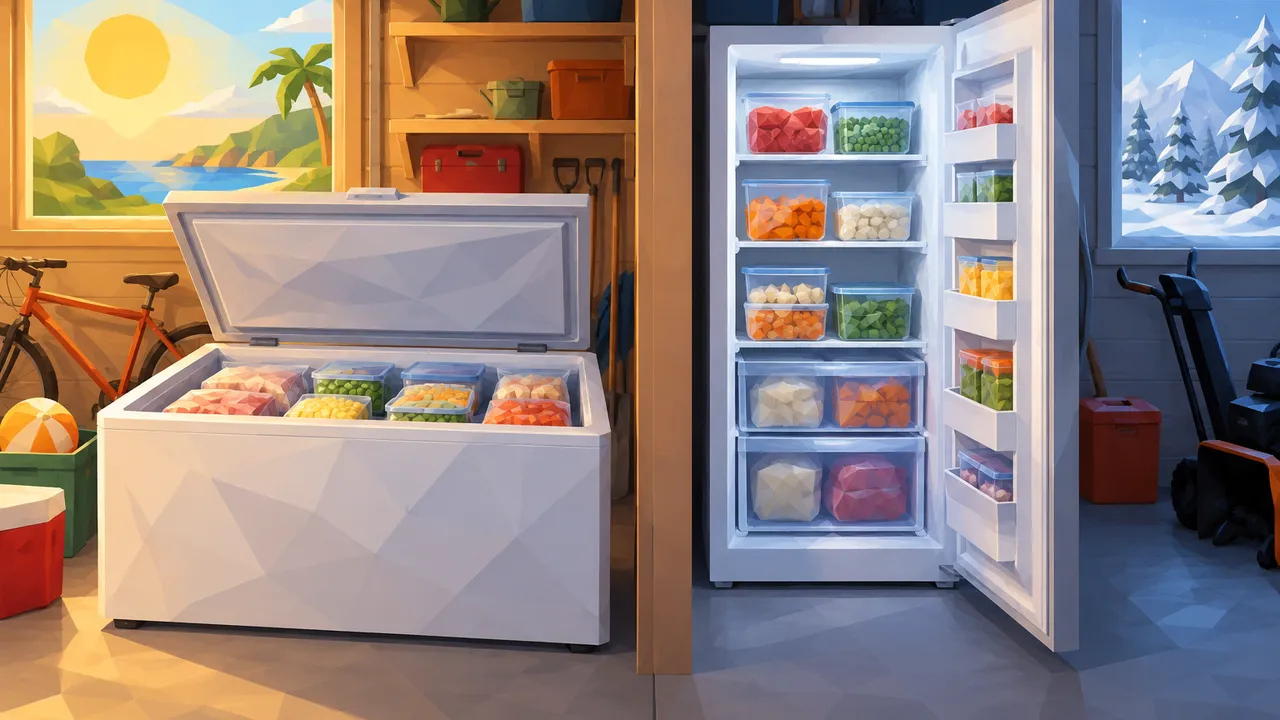
A garage freezer can make bulk shopping practical—or turn dinner into a digging expedition. Chest models generally favor flexible storage and lower energy use; uprights favor visibility and convenient access. The better choice depends on what gets stored, who retrieves it and how much room remains around the car. Include delivery, storage baskets and any necessary electrical work when setting a realistic purchase budget.
But the first question is whether the freezer can operate through the garage’s temperature swings. As of October 2026, shoppers should treat “garage-ready” as a claim to verify against the exact model’s documentation, not permission to install it in any unconditioned space.
1. Verify the temperature range before comparing features
Start with the manufacturer’s product page, then open the installation instructions or owner’s manual for the complete model number. Find the permitted ambient operating range: the temperature of the surrounding air, not the freezer’s internal setting. Some garage-rated models advertise operation around 0°F to 110°F, but that range is not universal. Other freezers require a substantially warmer location.
Measure the garage near the intended installation spot with a minimum/maximum thermometer or temperature logger. Outdoor forecasts cannot account for a sun-heated garage or its overnight lows. If the listing and manual disagree, obtain written clarification from the manufacturer before buying.
A few mild days of measurements cannot establish year-round suitability. Recheck during seasonal extremes, and choose another location if conditions exceed the approved range. Turning the thermostat colder does not expand the appliance’s permitted operating temperatures.
- Match the full model number, including suffixes.
- Check both minimum and maximum operating temperatures.
- Read location restrictions and ventilation requirements.
- Confirm warranty terms for the proposed installation.
2. Choose organization that matches how food gets used
An upright puts shelves and drawers in view, making it easier to rotate leftovers, vegetables and individually portioned meals. A chest freezer accommodates bulky cuts and irregular packages, but lower layers disappear quickly without a system. Advertised cubic feet do not reveal how much food will remain easy to find.
For chest storage, use removable baskets or freezer-safe bins grouped by meal or food type. Keep a simple inventory near the lid and date packages. With either style, follow loading instructions and avoid blocking vents. Anyone with limited reach should test an empty display model: bending into a deep chest can be harder than reaching an upright’s lower drawers.
Measure your largest routine packages, such as pizza boxes or roasting cuts, against usable shelf and basket dimensions. Assign an accessible “use first” zone for older food so new purchases do not repeatedly bury existing stock.
- Frequent small-item retrieval favors upright shelving.
- Large, uneven packages often fit chest storage better.
- Heavy baskets need manageable lifting weights.
3. Measure usable space, not just the footprint
A chest freezer usually occupies more floor area for comparable capacity, while an upright uses more vertical space. Neither can be judged by cabinet dimensions alone. Measure the delivery route, installation space and access path with the car parked where it normally sits.
Clearances vary by model; use the installation manual rather than a generic spacing rule. Confirm that the lid or door opens far enough to remove baskets and drawers. Keep access to electrical panels and garage exits unobstructed.
Check the floor’s slope and the model’s leveling provisions before delivery; garage slabs often slope toward the door. Verify that the supplied cord reaches a suitable outlet without stretching, and protect the installation spot from vehicle contact.
| Space check | Chest freezer | Upright freezer |
|---|---|---|
| Floor area | Typically wider | Typically narrower |
| Opening clearance | Room above lid | Room for door swing |
| Nearby obstacles | Overhead shelves | Walls beside hinges |
| Retrieval space | Room to lift baskets | Room to extend drawers |
4. Decide who will handle defrosting
Most chest freezers require manual defrosting. Uprights are available in manual-defrost and frost-free versions, so shape alone does not settle the maintenance question. Frost-free operation removes a recurring chore, but typically adds energy use compared with otherwise similar manual-defrost equipment. Packaging still matters: tightly sealed food loses less moisture.
For manual defrosting, follow the manufacturer’s frost-buildup threshold and procedure. Plan temporary frozen storage before switching the unit off, and check how its drain will work in the garage. Never chip ice with a sharp tool or apply an unapproved heater; either can damage the appliance. Schedule the job when supplies are low to reduce handling.
After defrosting, clean and dry the interior, replace any drain plug and restart according to the manual. Verify that the compartment has returned to its recommended storage temperature before transferring food back from temporary frozen storage.
- Check whether baskets lift out easily.
- Locate the drain and plan water collection.
- Keep towels and suitable food storage ready.
5. Compare electricity use without losing sight of food safety
Chest freezers often use less electricity than comparably sized frost-free uprights, but the specific models matter more than the category. Compare annual kilowatt-hours on the yellow EnergyGuide labels, using similar capacities and defrost types. Those federally required estimates reflect standardized testing, not your garage. Multiply annual kilowatt-hours by your electricity rate for a rough cost estimate; prolonged heat can increase consumption.
Check current listings through the official ENERGY STAR product finder and manufacturer specifications. Certification addresses efficiency; it does not establish garage suitability. Follow the manual’s electrical instructions and avoid extension cords. Finally, use a freezer thermometer: federal food-safety guidance recommends 0°F or below for frozen storage. An acceptable room temperature does not prove the food compartment is cold enough, especially after loading or a power interruption.
Plan for outages: an unopened full freezer generally keeps food safe about 48 hours, versus 24 hours when half full. These are estimates, not guarantees. Afterward, food that still contains ice crystals or measures 40°F or below can generally be refrozen.
Verify current specifications, warranty coverage and installation requirements with the manufacturer, and consult official federal energy and food-safety resources.
AI Assistance Used — AI assistance was used in researching and drafting this article. It was reviewed, edited, and fact-checked by Leah Fornier before publication.