Front-Load vs. Top-Load Washers: Choose for the Laundry You Actually Do
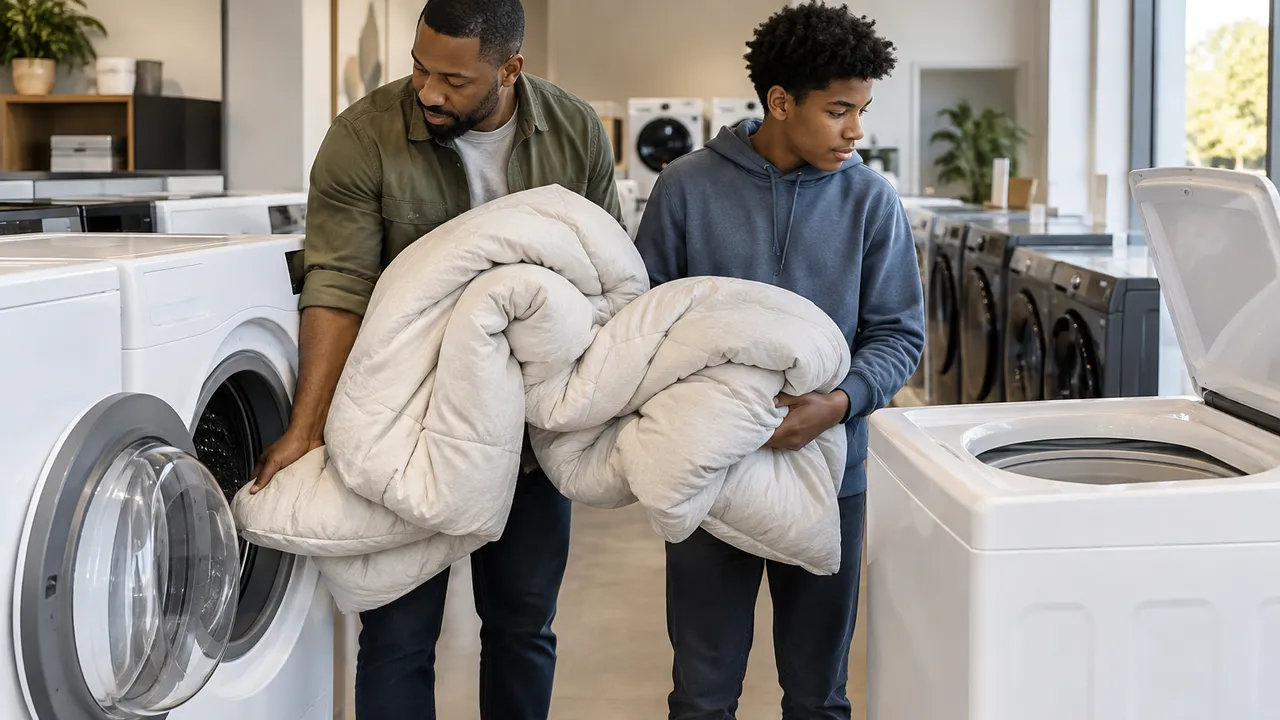
A washer can look enormous in a showroom and still struggle with your comforter—or make unloading socks a daily reach test. Cubic feet describe interior volume, not how effectively a machine moves bedding, removes stains or fits your body. The better starting point is the laundry you repeatedly do. Include recurring pet bedding, sports uniforms and towels in that inventory.
As of October 2026, the useful comparison remains three-way: top-loaders with a center agitator, top-loaders with a low-profile impeller, and front-loaders that tumble clothes through water. Each involves trade-offs. Before shopping, identify your hardest regular load, your available laundry time and who will load, unload and maintain the machine.
1. Understand what moves the laundry
An agitator uses a central post with fins to move fabric through the wash. An impeller uses a low-profile rotating plate and fabric-to-fabric movement, leaving more unobstructed space. A front-loader lifts and drops laundry in a horizontal drum. These mechanisms matter more than the top-load versus front-load label alone.
The table describes tendencies, not guarantees. Cycle programming, load size and detergent dosing can change results considerably. Compare independent testing for the exact model, and use the manufacturer's manual to check loading rules. A removable agitator changes the available space, but does not guarantee equivalent performance in both configurations.
Loading technique also differs: avoid wrapping sheets around an agitator, and distribute items as directed in an impeller basket rather than piling everything centrally.
| Design | Potential advantage | Watch for |
|---|---|---|
| Agitator top-load | Familiar loading; often shorter basic cycles | Center post complicates bulky loads |
| Impeller top-load | Open basket for larger items | Deep reach; careful load distribution |
| Front-load | Strong cleaning; efficient water use | Low door; gasket care |
2. Give bulky bedding its own test
A comforter fitting through the opening is only the first hurdle. It also needs room to circulate or tumble when wet. Dense quilts, lofty comforters and waterproof bedding behave differently, even when labeled for the same bed size. Follow both the textile care label and the washer's instructions; some waterproof items are restricted.
Front-loaders and impeller machines avoid a fixed center post, but neither is automatically suitable for every king-size comforter. Ask whether you may bring clean bedding to assess the opening and usable space. A showroom fit check cannot prove washing performance. An occasional oversized item may be better handled at a laundromat than dictate the entire purchase.
A single saturated item can create an unbalanced load, triggering redistribution attempts or reduced spin speed. Check the manual's remedy before adding more items.
- Check the manual for a bedding cycle and explicit load limits.
- Do not pack bedding tightly just because the lid or door closes.
- Check dryer suitability too; washed bedding still needs room to dry.
3. Compare cleaning and turnaround together
Front-loaders often perform well in independent stain-removal testing, but design alone does not determine the winner. An agitator's vigorous movement is not proof of better cleaning, and an impeller's lower visible water level is not proof of inadequate washing. For grass, food or oily workwear, pretreatment, suitable detergent and the care-label temperature limit matter. Check model-specific results for cleaning and fabric wear, rather than relying on claims about extra water or powerful action.
Agitator machines often offer shorter basic cycles; high-efficiency top-loaders and front-loaders may take longer, especially with sensing, heating or extra rinses. Some heavy-duty or sanitizing programs can run for hours. Ask to see estimated times for the cycles you will actually use, then check manual notes about load-dependent changes. Quick wash usually serves smaller, lightly soiled loads—not a full basket of stained uniforms. Stronger spin extraction can shorten drying, so compare wash-to-dry turnaround rather than wash time alone.
If heated washing matters, verify whether the model has an internal heater and which cycles use it; a hot setting alone proves neither.
4. Test bending, reaching and clearance
A front-loader requires bending unless it is elevated, but its opening may be easier to approach from a seated position. A compatible pedestal raises the drum and adds cost; it can also make the detergent drawer harder to reach. Do not assume a stacked installation or improvised platform will solve access problems.
Top-loaders avoid a low opening but require reaching over the rim and down to the basket bottom. Depth can matter more than overall machine height. Try both motions in the showroom without leaning heavily on the appliance. Check the installation guide for required clearances, and remember that a locking lid may prevent immediate midcycle access.
Measure the delivery route too, including doorways and tight turns. Confirm installed depth with hoses attached, not just the cabinet depth on the listing.
- Reach for a small item at the basket's lowest point.
- Check door swing, lid clearance and nearby cabinet interference.
- Have every regular user test loading and unloading.
5. Buy for maintenance you will actually do
Every washer needs cleaning. Front-loaders add a door gasket whose folds can retain moisture, lint and small objects. Top-loaders can accumulate detergent residue around dispensers and the basket. Odor is not inevitable with either design, but excess detergent and repeatedly leaving wet laundry inside increase the risk.
Read maintenance instructions before buying, not after an odor develops. Some machines have an owner-accessible drain-pump filter; others do not. Check the federal ENERGY STAR directory for certified models and compare the FTC-required EnergyGuide labels for standardized energy estimates. Neither substitutes for cleaning-performance testing or your household's actual operating costs.
For an accessible pump filter, check whether cleaning requires kneeling and draining residual water into a shallow tray. Nearby cabinetry should not block access.
- Use HE detergent when required and dose for soil and water hardness.
- Remove wet loads promptly; inspect seals and dispensers.
- Run the cleaning cycle at the manufacturer's recommended interval.
- Air the interior only when safe around children and pets.
Verify current specifications, care instructions, installation requirements and efficiency listings with manufacturer manuals and official federal sources before purchasing.
AI Assistance Used — AI assistance was used in researching and drafting this article. It was reviewed, edited, and fact-checked by Lisa Barber before publication.