Do You Need a Panel Upgrade for a Heat Pump, EV Charger or Induction Range?
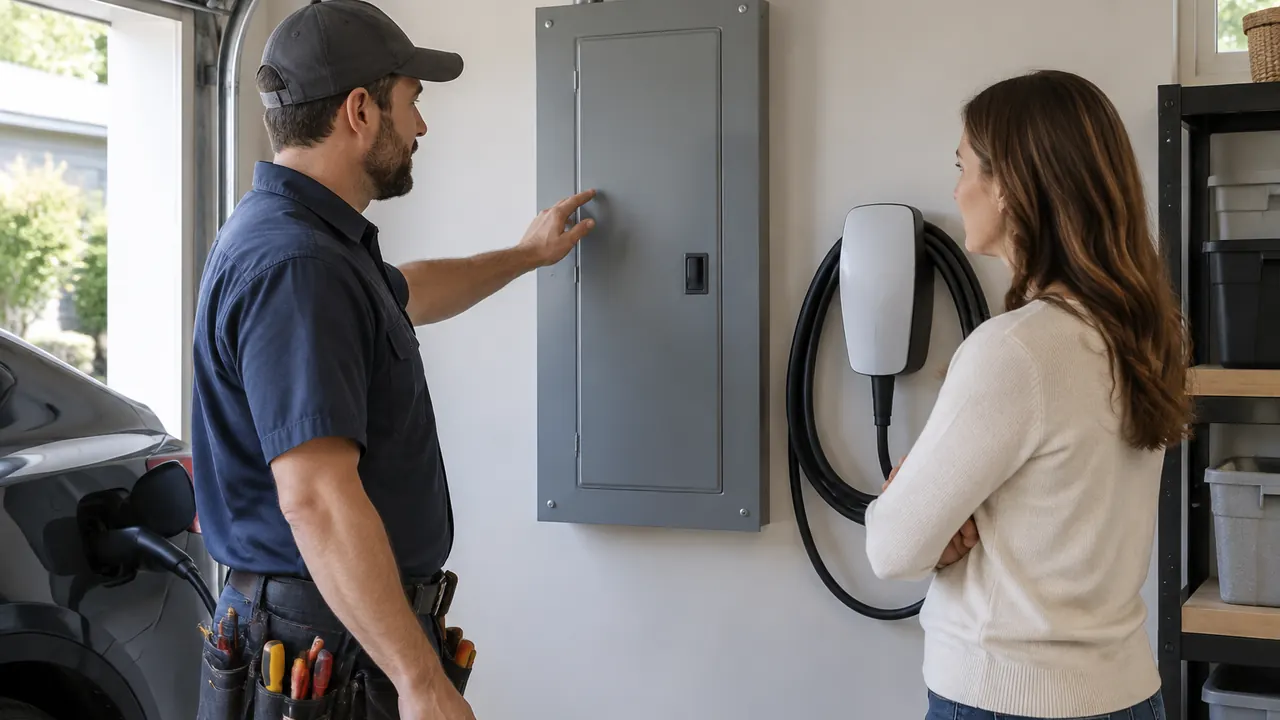
A heat pump, electric vehicle charger or induction range can add substantial electrical demand, but none automatically requires a larger electrical service. Some homes can accommodate new equipment as they are. Others need a new circuit, a different equipment configuration or approved controls that prevent certain loads from running together. A full service upgrade is one possible answer, not the starting assumption.
For homeowners planning electrification in 2026, the useful question is not whether the panel has empty slots. It is whether the existing service and distribution equipment can safely supply the proposed loads under the electrical code enforced locally. An electrician should evaluate that question before you commit to appliances or installation dates. Ask for a written assessment showing the assumptions behind the recommendation, including alternatives to increasing service capacity.
1. Empty breaker spaces are not a capacity test
Breaker spaces show where additional circuits might fit physically. They do not establish how much electricity the home can safely draw. A panel with several open spaces may already be near its calculated capacity. A crowded panel may have sufficient electrical capacity but need a properly supplied subpanel or another approved way to accommodate circuits.
Likewise, adding up the numbers printed on every breaker does not determine service demand. Those numbers describe individual circuit protection, and household equipment does not all operate at full output simultaneously. Electrical load calculations account for that diversity using specified methods, rather than a simple sum or a homeowner's guess.
The electrician also checks the actual service rating, panel rating, feeder and service conductors, disconnects and equipment condition. A label showing a 200-amp panel does not necessarily mean the house has a 200-amp service. Damage, corrosion, incompatible breakers or obsolete equipment can justify corrective work even when the load calculation passes.
- An open slot is physical room, not proof of available electrical capacity.
- A larger panel enclosure alone does not increase the home's service rating.
- Tandem breakers are allowed only where the panel's listing permits them.
- A subpanel creates circuit space but does not create additional service capacity.
2. What the electrician actually calculates
Expect an inventory of the home's size, existing appliances and proposed equipment. The electrician uses a calculation method permitted by the locally adopted electrical code, including applicable demand factors and rules for heating, cooling and other loads. Depending on the installation, qualifying measured-demand data may provide another permitted evaluation route. A low monthly electric bill is not a substitute: energy consumption over time differs from peak electrical demand.
Bring model numbers and installation instructions, not just appliance categories. Heat-pump backup heaters, an EV charger's configured output and a range's nameplate rating can materially change the result. Tell the electrician about planned additions, too, such as a heat-pump water heater or second vehicle.
In 2026, code adoption still varies by jurisdiction; publication of a newer National Electrical Code edition does not automatically make it local law. The electrician should identify the applicable rules and discuss unusual designs with the permitting authority. Utility requirements may separately govern service equipment and connections.
- Request the calculated existing and proposed demand, with the calculation method identified.
- Ask which new loads drive the result and whether equipment alternatives change it.
- Confirm whether any measured-demand approach needs additional monitoring or seasonal adjustments.
- Have the contractor identify permit, inspection and utility-coordination requirements.
3. Separate a panel replacement from a service upgrade
These terms often get bundled together in estimates, but they describe different work. Replacing a panel can address condition, breaker compatibility or circuit space while retaining the same service capacity. Increasing service capacity may require changes to the meter equipment, service conductors, grounding and bonding, and utility connection. The scope depends on the property and utility.
Before comparing bids, establish what each contractor is actually proposing. A relatively accessible installation is different from one requiring trenching, relocation or utility infrastructure work. Avoid treating a national price range as your likely bill; labor, access, local requirements and utility charges can dominate the total.
A service upgrade can be worthwhile when several substantial loads are planned and you want fewer operating constraints. It may also be necessary when an acceptable load-management design is unavailable. Still, ask whether safety repairs are required independently of electrification, so you understand which costs belong to which problem.
| Option | What it addresses | Important limitation |
|---|---|---|
| New branch circuit | Power delivery to one appliance | Does not increase service capacity |
| Panel replacement | Condition, compatibility or circuit space | May retain the existing service rating |
| Subpanel | Additional circuit locations | Limited by its feeder and upstream capacity |
| Service upgrade | Higher available service capacity | May require utility work and broader installation changes |
| Approved load management | Controls simultaneous electrical demand | Must suit the installation and applicable code |
4. Load management must be more than a promise
Load-management equipment can monitor demand and automatically reduce or interrupt a controlled load before an established limit is exceeded. For example, an EV charging system may lower charging power when other household loads rise, then restore it when capacity becomes available. Other arrangements prevent designated appliances from operating simultaneously.
That is different from promising not to charge while cooking. A phone reminder, ordinary timer or utility time-of-use schedule generally does not establish enforceable capacity protection. The proposed controls must be suitable and listed for their intended application, installed according to instructions, and accepted under the applicable code. The electrician should explain how their operation is reflected in the load calculation.
Ask what happens during communication loss, equipment failure or a power outage. Also ask which loads lose priority. Delayed vehicle charging may be acceptable; interrupted heating could be much less attractive. Controls do not fix deteriorated equipment or undersized wiring, and a device marketed as a circuit-sharing solution is not automatically approved for every pair of appliances.
- Confirm compatibility with the charger, panel and any current-monitoring hardware.
- Ask whether safe operation depends on internet access, subscriptions or proprietary services.
- Get the control settings, operating limits and inspection requirements in writing.
- Check whether future equipment changes require reconfiguration or a new calculation.
5. EV charging is often the most flexible load
Start with how much driving you need to replenish overnight, not the charger's maximum advertised output. Charging needs depend on daily mileage, vehicle efficiency, parking time and weather. A lower-power Level 2 installation may comfortably handle your routine while imposing less demand than a high-output unit. Level 1 charging can work for some low-mileage households, but it should use an appropriate circuit and receptacle, not an improvised extension-cord setup.
EV charging is generally treated as a continuous load. For a typical installation, a charger delivering 32 amps requires a circuit rated at least 40 amps, while 40-amp charging generally requires a 50-amp circuit. Those branch-circuit requirements are separate from the whole-home service calculation. Conductors, installation conditions and equipment instructions still matter.
If adjustable output is part of the design, the electrician must configure it through a code-compliant method; a casual user-selected app setting may not qualify as the basis for sizing. Compare slower charging with automatic power management and a service upgrade. Consider a second EV now, including whether two chargers could share an approved power limit.
| Charging approach | Potential advantage | What to verify |
|---|---|---|
| Level 1 | Lowest charging demand | Daily range recovery and circuit suitability |
| Lower-output Level 2 | Faster charging with reduced demand | Permitted output setting and overnight needs |
| Managed Level 2 | Adjusts charging to available capacity | Listed controls and local acceptance |
| Higher-output Level 2 | More energy delivered during short parking windows | Vehicle acceptance rate and electrical capacity |
6. Heat-pump and cooking choices change the equation
For heat pumps, look beyond the outdoor unit. Electric resistance backup heat can be a major additional load, and the air handler also needs to be included. Replacing an existing central air conditioner differs from adding whole-home electric heat where none existed. The electrical evaluation must reflect which components can operate together, including backup heat during defrost or cold conditions.
An HVAC contractor should size the system using a building heating-and-cooling load calculation and evaluate low-temperature performance for your climate. Better insulation and air sealing may reduce the required equipment size. A cold-climate model or an appropriately designed dual-fuel system may reduce reliance on resistance heat, but do not eliminate backup capacity merely to make the electrical numbers work.
For induction cooking, compare actual appliance ratings and required circuits. Replacing an electric range may allow reuse of an existing suitable circuit; replacing gas usually introduces a new substantial electrical load. Separate cooktops and wall ovens can have different requirements from a combined range. Where available, listed power-limited or battery-assisted products may offer alternatives, but verify installation requirements, cooking performance, serviceability and any operating limits before buying.
7. Get comparable plans before signing
Request itemized proposals based on the same equipment and future plans. Ideally, compare a straightforward installation using existing capacity, an approved managed-load design where feasible, and a service upgrade if warranted. Not every home needs all three bids, but each recommendation should explain why alternatives were accepted or rejected.
Have the contract identify permit responsibilities, utility coordination, inspection, wall repairs and commissioning. Ask for realistic scheduling tied to utility approval rather than a guaranteed completion date before the utility has reviewed the work. Verify any rebates or incentives directly for the installation date and specific equipment; eligibility and funding can change.
The best outcome is a safe, permitted system that supports your household's actual needs. Sometimes that means more service capacity. Sometimes it means a smaller charger, different backup-heat design or automatic controls. Empty breaker spaces cannot make that decision, but a documented evaluation can.
Consult licensed electrical and HVAC professionals and verify current local code, utility requirements, equipment specifications and incentive terms before committing to work.
AI Assistance Used — AI assistance was used in researching and drafting this article. It was reviewed, edited, and fact-checked by Leah Fornier before publication.