Does Microwaving Really Destroy Nutrients?
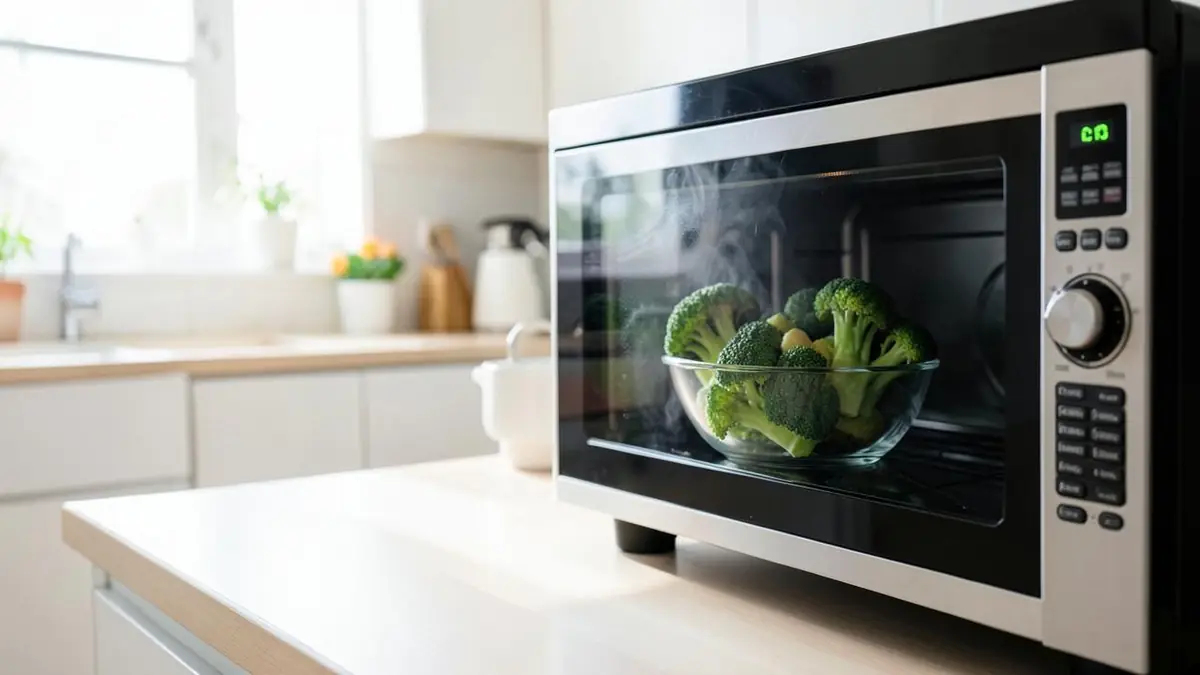
The microwave has an odd reputation. It is the most used cooking appliance in many kitchens and the most distrusted, with a persistent belief that it strips food of nutrition in a way that other cooking methods do not.
The research says close to the opposite. Nutrient loss during cooking is driven by three things — heat, time, and contact with water — and microwaving typically scores well on all three.
How a microwave heats food
Microwaves cause water molecules in food to rotate rapidly, generating heat throughout the food rather than conducting it inward from a hot surface. The radiation is non-ionising: it does not alter the chemical structure of nutrients or make food radioactive.
The practical consequence is speed. Food reaches temperature faster and spends less total time hot, which is the main reason nutrient retention compares favourably.
The nutrients that are actually vulnerable
Vitamin C and the B vitamins are water-soluble and heat-sensitive, so they are the ones measured in most cooking studies. Folate degrades readily, and thiamine is sensitive to prolonged heat.
Minerals do not degrade with heat at all, though they can leach into cooking water. Fat-soluble vitamins A, D, E, and K are relatively stable, and some, such as the carotenoids in carrots and tomatoes, become more available after cooking.
Boiling is usually the worst option
Boiling vegetables in a large volume of water and discarding the water is the most reliable way to lose water-soluble vitamins, with reported losses of up to half or more for vitamin C in some vegetables.
Microwaving with a small amount of water, or none, in a covered dish keeps those losses much lower. Steaming performs similarly well, and the two methods are close enough that convenience is a reasonable basis for choosing.
The garlic and broccoli question
Some studies have found that microwaving broccoli reduces certain beneficial compounds, and those findings are frequently cited. Others found the opposite, and the difference generally comes down to added water and cooking time.
For broccoli specifically, brief microwaving with minimal water retains sulforaphane precursors well. Chopping garlic and letting it stand for ten minutes before any cooking method preserves more of its active compounds.
Containers are the real safety issue
The genuine concern with microwaving is not the radiation but what the food is heated in. Some plastics release compounds when hot, particularly with fatty foods, and takeaway containers and cling film are not designed for it.
Glass and ceramic are the safe defaults. Where plastic is used, it should be explicitly labelled microwave-safe, and it should be replaced when scratched or warped.
Practical guidance
Use as little water as possible, cover the dish to trap steam, cook in short bursts, and stir partway to even out heating. Uneven heating is a food safety issue with meat and leftovers, so allow standing time.
If you do boil vegetables, keep the water for stock or gravy. That recovers most of the leached vitamins and minerals that would otherwise go down the sink.
This article is general information and not medical or food safety advice. Follow manufacturer guidance for cookware and reheating.
AI Assistance Used — AI assistance was used in researching and drafting this article. It was reviewed, edited, and fact-checked by Leah Fornier before publication.