How to Choose a Dehumidifier for a Damp Basement
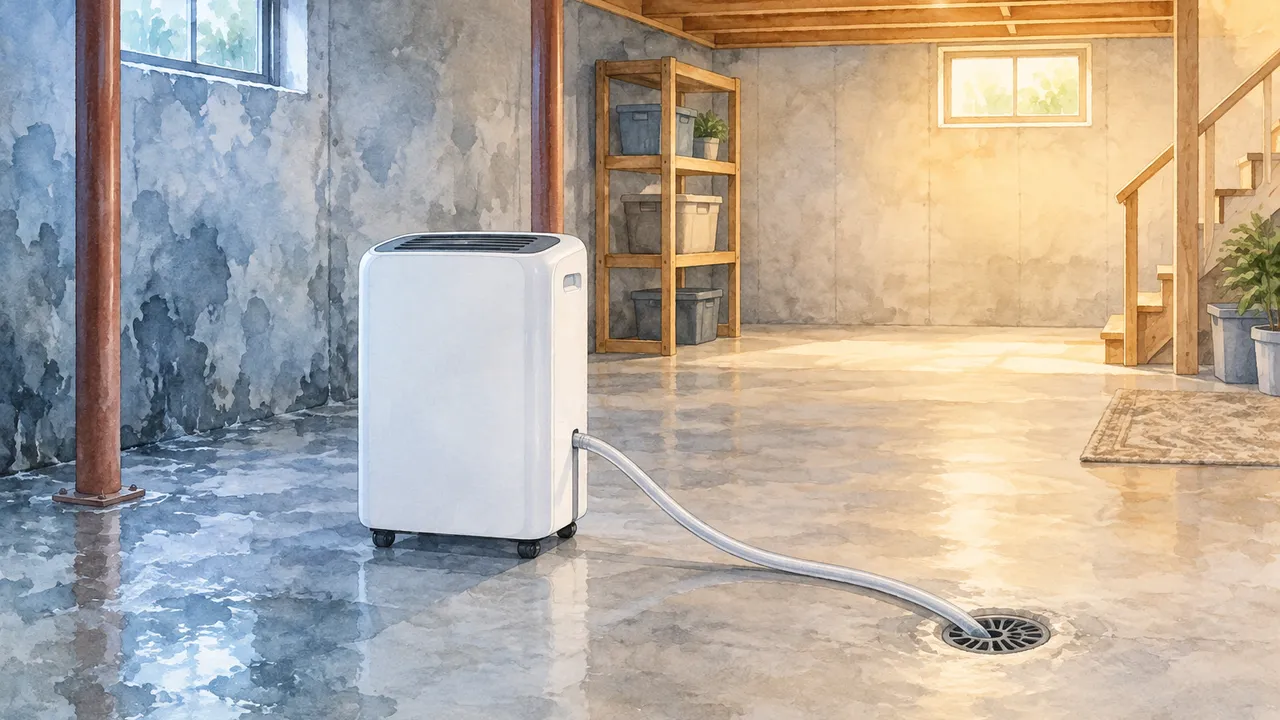
A basement dehumidifier should match the moisture it must remove, not just the floor area printed on its box. Two equally sized basements can need different machines: one may feel slightly clammy in summer, while another collects condensation or receives a steady supply of humid outdoor air. The best choice also depends on whether you can empty a bucket regularly or need reliable drainage while away.
For US shoppers comparing models in October 2026, the useful filters are measured humidity, basement temperature, standardized pint capacity, drainage options and product safety. Start by identifying the water source. A dehumidifier can control airborne moisture, but it cannot repair a leaking foundation or make a flooded basement safe.
1. Measure the problem before choosing capacity
Place a separate digital hygrometer away from the dehumidifier’s exhaust, windows and obvious wet spots. Record humidity and temperature over several days, including rainy weather. The Environmental Protection Agency recommends keeping indoor relative humidity below 60%, ideally between 30% and 50%. Around 45% to 50% is a practical starting target.
Check gutters, downspouts, plumbing and exterior grading before treating continuous dampness as an appliance-sizing problem. Visible mold needs appropriate cleanup and moisture correction; simply drying the air does not remove it. Use these observations to distinguish an ordinary humidity load from water intrusion:
Log activities alongside readings: laundry, open windows and showers in a basement bathroom can explain humidity spikes. Confirm that dryer and bathroom exhaust ducts terminate outdoors, not in the basement, crawlspace or another enclosed part of the building.
- Occasional clamminess: track readings before paying for extra capacity.
- Persistent condensation: investigate humid-air entry, cold surfaces and inadequate ventilation control.
- Puddles or wet foundation walls: correct the water source before sizing equipment.
2. Match the machine to basement temperature
Most portable basement units use a compressor and cold coils to collect water. Their output falls as the room cools, and frost can interrupt collection. A model advertised for a large space may perform poorly in a chilly basement, even when its published capacity looks generous.
Read the operating-temperature range in the manufacturer’s manual, not just a retailer’s listing. Some compressor models operate down to roughly 40°F, but that does not mean they deliver their rated output there. For persistently colder spaces, investigate desiccant models while comparing their power consumption and heat output.
If the basement drops below the stated operating minimum, do not assume automatic defrost makes continued use appropriate. Follow the manual’s shutdown and storage directions, and protect collected water, drain hoses and pumps from freezing.
- Measure temperature where the unit will run, including the coldest season.
- Look for automatic defrost, while recognizing that defrost cycles interrupt extraction.
- Compare documented low-temperature performance; “basement ready” alone proves little.
3. Compare standardized pints, not coverage promises
Capacity means pints removed per day under specified test conditions, not bucket volume. Current US Department of Energy testing for portable dehumidifiers uses cooler conditions than older testing, so older and newer ratings are not directly interchangeable. Compare products under the same standard; avoid relying on a universal conversion formula.
Common portable choices span roughly 20 to 50 pints per day. Treat the ranges below as shopping starting points, not sizing guarantees. Layout, air exchange and moisture sources matter alongside area. Closed rooms may need airflow improvements or separate equipment, rather than one larger machine in a distant corner.
Compare bucket capacity separately: a unit actually collecting 50 pints daily would fill a 12-pint bucket roughly four times per day. Actual collection varies with conditions, but this calculation exposes the maintenance burden hidden behind a high extraction rating.
| Conditions after fixing leaks | Capacity range to investigate | Key check |
|---|---|---|
| Mild, intermittent dampness | 20–25 pints/day | Can humidity stay controlled? |
| Persistent, moderate dampness | 30–35 pints/day | Does air circulate throughout? |
| Heavy humidity load | 45–50 pints/day | Is moisture still entering? |
4. Choose drainage before choosing convenience features
A full bucket stops most portable units, making drainage essential when nobody checks the basement daily. Gravity drainage generally requires the hose to slope continuously downward to an approved drain below the outlet. Verify the route before purchase: a hose crossing upward over a threshold can prevent reliable drainage.
If water must travel uphill, consider a built-in pump or a compatible external condensate pump. Check maximum lift, hose requirements and permitted discharge locations in the manual and local plumbing rules. Test drainage while present, inspect connections regularly and keep the hose from becoming a trip hazard.
Plan access for cleaning the bucket, hose and pump reservoir according to the manufacturer’s instructions. Slime and sediment can obstruct drainage even when the slope is correct. Collected condensate is not drinking water; keep it away from pets.
- Bucket only: prioritize manageable weight, easy removal and automatic full-bucket shutoff.
- Gravity hose: confirm outlet height, required hose size and an unobstructed downhill path.
- Pump drainage: verify lift limits and what happens if pumping fails.
5. Check recalls, efficiency and everyday usability
Before buying, search the Consumer Product Safety Commission’s recall database using the brand and exact model. Match serial numbers or date codes when a notice specifies them. Check used units especially carefully, since recalled dehumidifiers can reappear for sale. An absent search result is not a safety certification; register the appliance for future notices.
Compare ENERGY STAR listings and integrated energy factor, which measures water removal per unit of electricity; higher is generally better under comparable testing. Check filter access, noise, warranty and required clearance. Use the grounded outlet specified by the manual, not an extension cord or power strip. Recheck humidity independently after installation and reassess leaks or airflow if control remains poor.
Estimate operating cost using kilowatts multiplied by running hours and your electricity rate. For example, 500 watts over eight hours at $0.20 per kilowatt-hour costs $0.80. Actual consumption depends on compressor cycling, fan operation and basement conditions.
Verify current specifications, recall status and installation requirements through official government resources and manufacturer documentation.
AI Assistance Used — AI assistance was used in researching and drafting this article. It was reviewed, edited, and fact-checked by Leah Fornier before publication.