Packing Carry-on Only When Every Airline Has Different Limits
Packing carry-on only starts with your itinerary, not your suitcase. A bag that works on an outbound flight can become a paid checked bag on the return, and a connecting airline may impose a lower weight limit or allow fewer pieces. Even when flights appear together in one reservation, do not assume one cabin baggage policy covers the whole trip. The airline operating each flight, your fare and the aircraft can all affect what stays with you.
For travel in 2026, treat a bag described as “cabin approved” as a starting point, not a guarantee. Check current airline rules before buying a fare, verify them again before departure, and measure the luggage you actually plan to pack. The practical goal is to meet the tightest applicable limits while keeping a small, removable essentials kit ready if your suitcase must travel in the hold.
1. Build a baggage checklist for every flight
List every flight segment, including short feeder flights, separately booked connections and the journey home. On your booking confirmation, find the words “operated by.” A ticket sold under one airline’s name may include a flight operated by another. Start with the operating carrier’s official cabin baggage page, then compare it with the allowance shown in your reservation. If they conflict, ask the airline to clarify your specific flight and save its written response.
Record both the physical limits and your entitlement to bring each item. An airline’s maximum suitcase size does not mean your fare includes that suitcase. Booking details matter especially when an itinerary mixes full-service airlines with carriers that sell overhead-bin baggage separately. Use the checklist below for each leg rather than keeping one general note for the trip.
- Record the flight date, operating airline, route and booked fare or cabin.
- Write down the allowed number of cabin pieces and whether an overhead bag costs extra.
- Copy the maximum dimensions for both the carry-on and personal item, including the units.
- Note each weight limit and whether it applies separately or to both bags combined.
- Save the official policy link and any baggage purchase confirmation where you can access them offline.
2. Measure the outside, then choose the limiting allowance
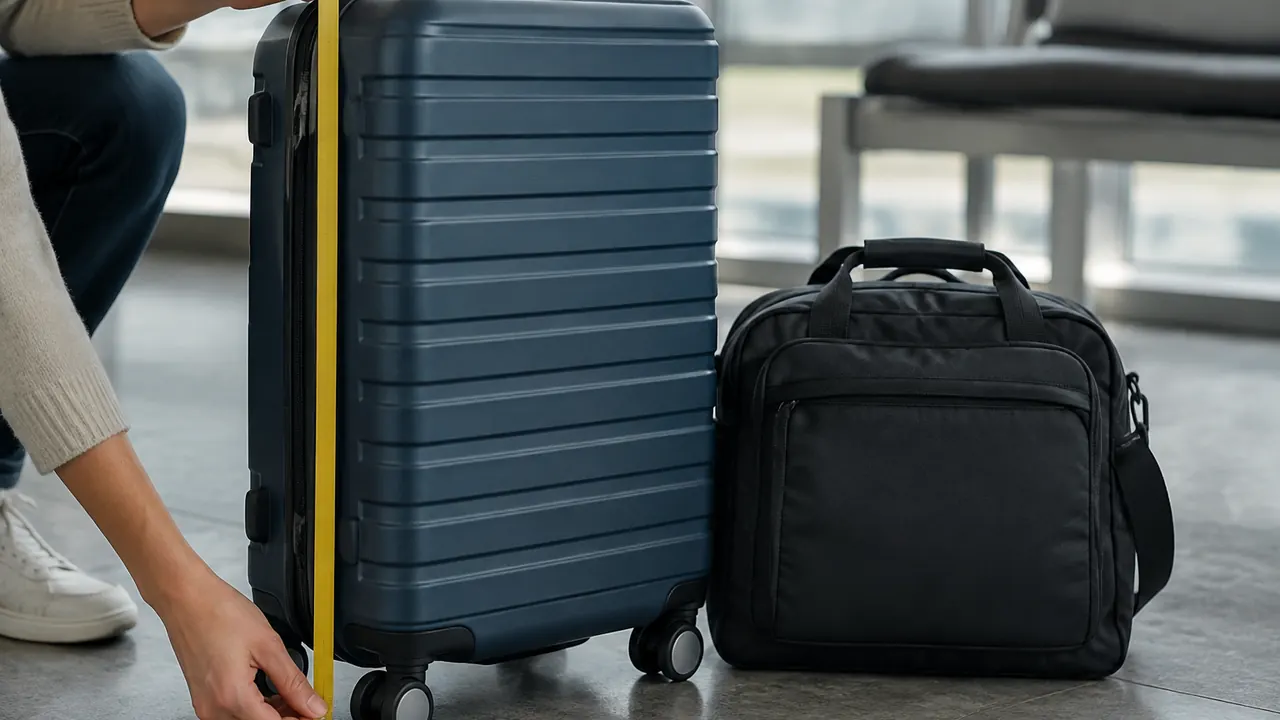
Measure a packed suitcase from its farthest outside points, including wheels, handles, feet and filled exterior pockets. Retail listings sometimes emphasize the case body rather than the complete exterior, so check the manufacturer’s measurement notes and use your own tape. An expansion zipper can push a compliant bag beyond the limit. Soft luggage is not automatically exempt: once packed tightly, it may be unable to fit the airline’s sizer.
Compare length, width and depth individually across your flights. Do not assume equal total dimensions mean two bags are interchangeable; a wider bag can fail even if it is shorter. The hypothetical example below shows why you should use the smallest permitted measurement in each corresponding dimension. None of these rows represents a named airline’s current policy.
In this example, a bag no larger than 55 × 35 × 20 centimeters covers all three listed size limits. Check whether an airline publishes an official equivalent in inches rather than rounding a conversion upward yourself. Leave a little packing space so an overstuffed pocket does not erase your margin. If you already own a larger suitcase, compare the cost of buying smaller luggage with purchasing checked baggage instead.
| Hypothetical flight | Maximum exterior size | What it changes |
|---|---|---|
| Outbound | 56 × 36 × 23 cm | Initial size ceiling |
| Connection | 55 × 40 × 20 cm | Shorter and shallower |
| Return | 55 × 35 × 25 cm | Narrower |
| Shared size envelope | 55 × 35 × 20 cm | Fits all listed dimensions |
3. Weigh the whole load, not just the suitcase
Weight can be the harder restriction, particularly when a trip includes international or regional flights. Some carriers set separate allowances for an overhead bag and personal item; others cap their combined weight. Some publish no numerical cabin weight limit but require you to handle or lift your bag yourself, subject to applicable assistance policies. Read the actual wording instead of relying on what happened on a previous flight.
Weigh your packed bags with a luggage scale, including the electronics, chargers and toiletries you will carry on departure day. A kitchen scale can help identify surprisingly heavy individual items. If your bathroom scale is the only option, compare your weight while holding the bag with your weight alone, but allow for its limited precision. Aim below the ceiling rather than exactly at it.
The lightest applicable allowance should guide your packing unless you deliberately purchase another option. Moving a laptop into your tote helps only when the rules permit it; it does nothing under a combined-weight cap. Do not plan around gate staff overlooking a heavy bag. Leave room in the allowance for purchases and anything added during the trip, including gifts or a water bottle filled after security.
| Policy wording | What to check | Packing consequence |
|---|---|---|
| Carry-on weight limit | Whether a separate personal-item limit applies | Weigh each bag as required |
| Combined cabin allowance | Which items count toward the total | Weigh included pieces together |
| No published numerical limit | Handling requirements and other conditions | Keep the bag manageable |
| Additional cabin weight available | Purchase deadline, price and size restrictions | Buy only after confirming eligibility |
4. Treat the personal item as a separate rulebook
A personal item is usually a bag intended to fit under the seat ahead, but airlines define its permitted size and contents differently. A backpack is not automatically a personal item, and a small rolling case is not automatically acceptable underseat luggage. Check the published dimensions, then consider whether the packed bag can actually fit without blocking the aisle or your foot space. Aircraft equipment can reduce usable underseat space.
Read the fare conditions before assuming you can bring both bags. Some basic or unbundled fares include only an underseat item, with an overhead carry-on available for an additional charge. Priority boarding and cabin baggage may be sold together, but the details are carrier-specific. Bulkhead seats generally require bags to be stowed elsewhere for takeoff and landing, so an underseat-size bag does not guarantee continuous access.
- Confirm whether a purse, camera bag or laptop sleeve counts as your personal item rather than an extra piece.
- Check exceptions for medical devices, mobility aids, infant supplies and other special items directly with the airline.
- Do not assume airport shopping or duty-free bags are exempt from piece or weight limits.
- Choose a personal item that closes securely and can hold your essentials without exceeding its own allowance.
5. Pack a small wardrobe and check the security rules
Once you know the limits, make a packing list that reflects the trip rather than the suitcase’s remaining space. Build outfits around repeatable layers, choose shoes that serve more than one purpose and plan laundry for longer stays. Packing cubes can organize clothes, but they add weight; compression creates space without reducing the load. Check accommodation amenities before packing a hair dryer, bulky towel or duplicate toiletries.
Security screening rules are separate from airline baggage allowances. For departures from US airports, the standard TSA liquids rule generally limits liquids, gels and aerosols to containers of 3.4 ounces, or 100 milliliters, in one quart-size bag, with exceptions including qualifying medications and infant nourishment. Other countries and connecting airports may use different procedures. Check official airport or government guidance for every place where you will be screened, rather than assuming newer scanners eliminate restrictions.
- Wear your bulkiest practical shoes and an appropriate outer layer instead of packing duplicates.
- Choose refillable toiletries only in containers accepted at your screening checkpoints.
- Verify destination rules for prescription medicines and keep identifying labels or documentation as appropriate.
- Leave room for the return trip; compression is not a solution to a weight overage.
6. Prepare for a gate check before you reach the gate
A compliant carry-on can still be checked because overhead bins are full or a small aircraft cannot accommodate it. Prepare a zipped essentials pouch that fits inside your permitted personal item, not a third bag you assume you can carry separately. Keep it accessible throughout boarding. Include medications needed during the journey, travel documents, keys, valuables and essential electronics. A change of underwear and basic toiletries can help if delivery is delayed.
Before surrendering the suitcase, remove power banks and spare lithium batteries; these belong in the cabin, with terminals protected against short circuits. E-cigarettes and vaping devices must also stay out of checked baggage and must not be used or charged aboard. Check airline limits on battery capacity, quantity and onboard storage or use. Smart luggage may require battery removal; ask before handing it over.
- Move the essentials pouch into your personal item before staff take the suitcase.
- Remove laptops and other valuables; follow instructions for any permitted devices left inside.
- Ask whether collection is at the aircraft door, a transfer point or baggage claim.
- Confirm the destination on the tag, keep the claim receipt and photograph the bag.
7. Recheck the booking and decide when checking makes sense
A few days before departure, reopen your reservation and the operating airlines’ baggage pages. Aircraft swaps, schedule changes or rebooking can alter your plan. Confirm purchased extras still appear, check deadlines for adding baggage, and compare advance charges with airport charges. Carrying screenshots can help resolve confusion, but they do not override current safety instructions or guarantee space in the cabin.
At the airport, resolve a questionable bag before boarding starts. Ask whether a proposed check is a complimentary space-related gate check or a charge for exceeding your allowance; the distinction matters. On separate tickets, also verify how a checked bag would affect collection, security screening and your connection time. If essential equipment or the trip’s clothing needs cannot reasonably fit, buying checked baggage in advance may be the better choice. Carry-on only should simplify travel, not depend on stretching rules or hiding extra pieces.
Baggage allowances, fees and security requirements can change; verify current official rules for every operating airline and screening airport before travel.
AI Assistance Used — AI assistance was used in researching and drafting this article. It was reviewed, edited, and fact-checked by Leah Fornier before publication.