Bone Density Tests: Who Needs One Before a Fracture Happens?
Osteoporosis often develops without pain or other obvious symptoms. A broken wrist after a simple fall, a hip fracture or an unexpectedly compressed spinal bone may be the first sign. A bone density test can help identify weakened bones earlier, when there is time to discuss medication, fall prevention and other steps to lower fracture risk. But deciding who needs testing is not simply a matter of reaching a particular birthday.
For women and men, the decision also depends on past fractures, medicines, weight and conditions that affect bone health. U.S. recommendations available in 2026 are not identical across organizations, especially for men. Understanding what those recommendations cover—and what a scan cannot tell you—can help you ask better questions before an injury forces the issue.
1. For women, age 65 is a clear screening milestone
The U.S. Preventive Services Task Force recommends osteoporosis screening for women 65 and older, and for postmenopausal women younger than 65 who have increased fracture risk based on a clinical risk assessment. Its 2025 recommendation remains an important reference for 2026 appointments. For younger postmenopausal women, clinicians first look for risk factors, then may use a formal assessment tool to decide whether a bone density scan is appropriate.
These screening recommendations apply to people without known osteoporosis or a history of fragility fractures. They do not cover every situation, including bone loss caused by certain illnesses or medicines. Someone taking long-term steroids, for example, may need a separate evaluation rather than waiting to qualify under routine screening rules. Menopause before age 45, especially very early loss of ovarian function, also deserves discussion, although it does not create one universal testing age.
- At 65 or older: Ask whether you have had an appropriate central DXA scan and whether follow-up is due.
- After menopause but before 65: Mention low body weight, parental hip fracture, smoking and alcohol use.
- Before menopause: Routine screening is generally not recommended; fractures or an underlying condition can justify individualized testing.
2. Men need a risk-based conversation, not reassurance by omission
Osteoporosis is not exclusively a women's disease. Men can lose bone with aging, low testosterone, medical illness and treatment for conditions such as prostate cancer. Yet the Task Force concludes that evidence is insufficient to determine the balance of benefits and harms of routine screening in men. That is an evidence gap, not a finding that testing never helps or that men cannot have dangerous bone loss.
Other professional guidance takes a more proactive approach. The Bone Health and Osteoporosis Foundation recommends bone density testing for men 70 and older, and for men ages 50 to 69 with risk factors. Its guidance also supports testing adults 50 and older who have had a fracture. A clinician may therefore reasonably recommend a scan even though the Task Force does not endorse population-wide screening for men.
- Bring up prior fractures, height loss, low body weight and a parent who broke a hip.
- Report testosterone deficiency, treatment that suppresses testosterone, smoking and heavy alcohol use.
- Ask which guideline informs the recommendation and whether the result would change your care.
- Check coverage separately: A medical recommendation and an insurer's payment criteria are not always the same.
3. A fracture or certain medications can move testing earlier
A fragility fracture generally means a bone broke after a fall from standing height or less, or similarly low-level trauma. Hip and spinal fractures are particularly important warning signs. In postmenopausal women and men 50 and older, either can justify osteoporosis treatment regardless of the bone density score, after appropriate evaluation. Other fractures, including those of the wrist, pelvis or upper arm, should trigger a bone health review rather than being dismissed as bad luck.
Medication exposure can also change the timetable. Systemic glucocorticoids, such as prednisone taken for months, can raise fracture risk quickly; specialty guidance calls for early risk assessment and often DXA with vertebral assessment. The dose, duration and underlying disease matter. Aromatase inhibitors for breast cancer and androgen-deprivation therapy for prostate cancer are additional reasons to discuss bone protection. Do not stop a prescribed medicine on your own.
- Ask about testing if you have rheumatoid arthritis, malabsorption such as celiac disease, or a history of bariatric surgery.
- Discuss overactive thyroid or parathyroid disease, prolonged immobility, or substantial unexplained weight loss.
- Report new back pain or height loss; these may prompt spine imaging for an unrecognized vertebral fracture.
4. What a DXA scan measures—and what its scores mean
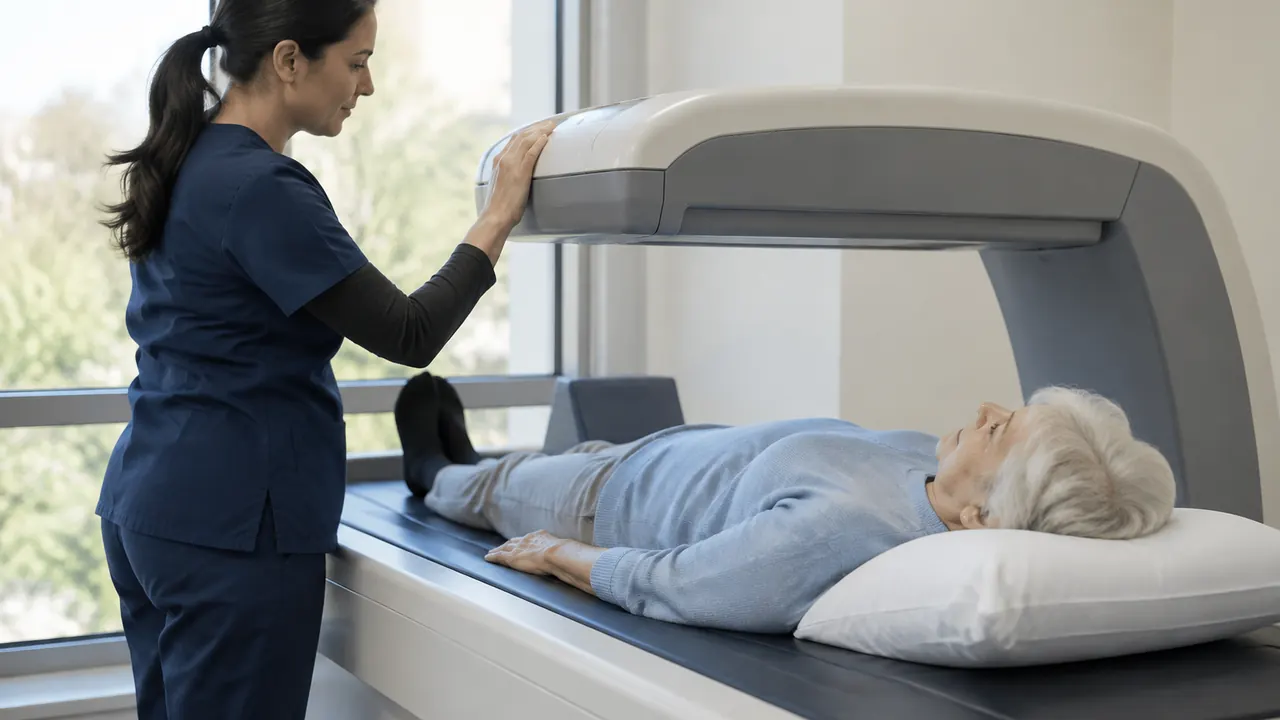
A central dual-energy X-ray absorptiometry scan, usually called DXA, measures bone mineral density at the hip and lumbar spine. You lie on a padded table while a scanner passes above you. The test is noninvasive and uses a very small radiation dose. Sometimes the forearm is measured when the hip or spine cannot be interpreted reliably or for particular medical reasons. Heel ultrasound and other peripheral tests are not interchangeable with a central DXA for diagnosis and monitoring.
For postmenopausal women and men 50 and older, results usually include a T-score: how far density differs from a young-adult reference average. In younger adults, a Z-score, which compares density with an age-appropriate reference population, is generally more useful. A Z-score of minus 2.0 or lower means density is below the expected range for age; it is not, by itself, the same as an osteoporosis diagnosis. Ask which score applies to you.
| T-score at an appropriate diagnostic site | Usual category | What to understand |
|---|---|---|
| Minus 1.0 or higher | Normal bone density | Does not rule out fracture risk |
| Below minus 1.0 but above minus 2.5 | Low bone mass, often called osteopenia | Treatment may be appropriate when overall risk is high |
| Minus 2.5 or lower | Osteoporosis | Usually supports treatment consideration after clinical evaluation |
5. FRAX estimates probability, not your personal future
FRAX is a widely used calculator that estimates the 10-year probability of hip fracture and major osteoporotic fracture: hip, clinical spine, forearm or shoulder. It uses age, sex, body size and selected risk factors, with or without femoral-neck bone density. When density is entered, it is the measurement from that specific hip region, not simply the lowest T-score anywhere on your report. The calculator is designed for ages 40 through 90.
In U.S. practice, commonly used treatment thresholds for postmenopausal women and men 50 and older with low bone mass are a 10-year hip-fracture probability of at least 3% or a major osteoporotic fracture probability of at least 20%. These are decision thresholds, not guarantees or universal rules. FRAX does not fully capture falls, how recent or numerous fractures were, or the dose of every risky medication. Type 2 diabetes and a spine score much lower than the hip score can also complicate interpretation. A clinician may judge risk higher than the displayed estimate. Ask which country model and inputs were used, and remember that FRAX is not a tool for measuring whether osteoporosis treatment is working.
6. Why treatment is not decided by one number
Two people with the same T-score can have very different chances of breaking a bone. Age, falls, previous fractures and medicines all matter. A person with osteopenia and a hip fracture may need treatment, while an unexpectedly low reading in a younger adult may call first for investigation of an underlying cause. Arthritis, spinal degeneration, positioning problems and other artifacts can distort DXA readings, sometimes making spinal density look falsely reassuring. The interpreting clinician should assess scan quality and usable measurement sites.
Before choosing medication, clinicians may order blood tests to look for contributors such as vitamin D deficiency, abnormal calcium levels, kidney disease or thyroid problems. Treatment choice also depends on kidney function, swallowing or digestive issues, fracture severity, preferences and the ability to follow a dosing schedule. Very high-risk patients may benefit from bone-building treatment followed by an antiresorptive medicine. Whatever is selected, ask about expected benefit, important adverse effects and the plan for continuing or stopping it. Denosumab, in particular, should not be delayed or stopped without a transition plan because fracture risk can rebound.
7. Make the appointment useful, and plan the next step
Bring a medication list, details of fractures and any previous DXA reports. Tell the imaging center about possible pregnancy, recent contrast imaging or nuclear medicine testing, and anything that makes lying flat difficult. Follow its preparation instructions; many centers ask patients to avoid calcium supplements for 24 hours beforehand. If possible, use the same facility and machine for follow-up, because small differences between scanners can look like biological change.
Repeat testing should have a purpose, not simply follow an annual calendar. After starting or changing treatment, many guidelines suggest checking density in roughly one to two years, then tailoring the interval. Untreated people at lower risk may wait longer. A meaningful change must exceed the facility's measurement variability; a tiny score shift may be noise. Meanwhile, adequate dietary calcium, appropriate vitamin D, strength and balance exercise, smoking cessation and fall prevention support bone health, but do not replace medication when fracture risk warrants it.
Consult a qualified health professional about your fracture risk, and verify current screening guidance and insurance coverage before scheduling testing.
AI Assistance Used — AI assistance was used in researching and drafting this article. It was reviewed, edited, and fact-checked by Leah Fornier before publication.