The Appliance Price Is Only Part of the Bill
A refrigerator advertised at a good price can become a much bigger purchase by the time it is running in your kitchen. Delivery may stop at the doorway. Installation may cover only a straightforward connection to existing utilities. The cord, water line, stacking kit or old-unit pickup may be separate. None of those charges necessarily makes an offer unreasonable, but each belongs in your budget before you choose a model or schedule delivery.
For a March 2026 purchase, compare the finished job, not just the appliance price or the checkout page’s installation button. Online packages and local installer quotes can define the same service differently. The worksheet below helps you identify those differences, document your home’s conditions and ask for a written scope. Your goal is a usable appliance installed according to its instructions and applicable local requirements, with the old machine gone if that is part of the agreement.
1. Build one worksheet for the entire job
Start with the exact model number, seller, quote date and expiration date. Record the appliance price after immediate discounts, then add every charge needed to put it into service. Keep sales tax as its own entry because the tax treatment of delivery, labor and other services can vary. A rebate that arrives later is not money available to pay the installer today.
Use the same worksheet for every offer. Mark each line as included, separately priced, not needed or unresolved; a blank is too easy to mistake for zero. Where a contractor cannot price work without inspecting the site, ask what the inspection costs and whether it is credited toward the job. Keep optional protection plans separate from the required installation total so you can compare equivalent offers.
- Record who supplies each part and who performs each task, including any subcontracted plumbing or electrical work.
- Add deposits and payment dates without counting the same charge twice in your final total.
- Keep a separate contingency for unresolved conditions; do not treat an allowance as a firm price.
| Worksheet line | What to enter | What to verify |
|---|---|---|
| Appliance and tax | Price after immediate discounts; applicable tax | Exact model and taxable charges |
| Delivery and access | Delivery, stairs and special-handling charges | Placement location and access limits |
| Hookup labor and accessories | Installation labor; cords, hoses, kits and fittings | Required parts and included testing |
| Site work and permits | Trade work, alterations, permit and inspection charges | Written scope and responsible party |
| Removal and disposal | Disconnection, haul-away and disposal charges | Accepted condition and pickup timing |
| Total installed cost | Sum of required charges, without double counting | Unresolved items shown separately |
2. Separate delivery from a working installation
Delivery is not a universal service description. Curbside, threshold, room-of-choice and installation packages can involve different responsibilities. Ask whether the crew brings the appliance inside, unpacks it, positions it, levels it and removes packaging. Check for charges involving stairs, elevators, long carries, restricted parking or a second trip. In an apartment or condominium, confirm loading reservations, delivery hours and any certificate-of-insurance requirement before booking.
Installation needs its own definition. A basic hookup commonly assumes compatible, accessible and serviceable connections already exist; it does not necessarily include relocating pipes, replacing a shutoff valve or adding a circuit. Ask what happens if the crew declines the connection: Can it leave the new unit safely, does the installation fee get refunded, and what does a return visit cost? Establish who checks for leaks, verifies operation and explains the completed work. Coordinate delivery with any required trade work so your new appliance does not sit unusable while you wait for another appointment.
- Ask whether removing and reinstalling appliance doors or home doors is included when access is tight.
- Identify who handles floor protection and how to report damage discovered during delivery.
- Request a written list of conditions that would stop installation or trigger extra charges.
3. Price the parts and utility connections by model
Required accessories are not interchangeable extras. Use the model’s installation instructions to identify approved parts, then compare that list with the seller’s package. A washer may need new inlet hoses; a refrigerator may need a compatible water-supply line; and a stacked laundry pair requires the correct stacking kit. Some electric ranges and dryers are sold without a power cord. Verify what comes in the box rather than assuming the display model tells you.
The bigger expense can be making the home compatible. A replacement gas appliance still needs a suitable shutoff and connector, with any required leak testing performed by a qualified installer. Moving from gas cooking to an electric range or induction cooktop may require circuit work and an assessment of panel capacity. Electric dryers also differ: a heat-pump model’s voltage, drainage and clearance requirements must be checked individually. Do not assume that matching an appliance category means matching its connections.
- Dishwasher: Confirm the supply connection, drain routing, electrical connection and any locally required air-gap arrangement.
- Vented dryer: Price suitable transition ducting and check the exhaust path, permitted length and exterior termination.
- Range: Include installation of the specified anti-tip device and verification that it engages properly.
4. Measure the opening, the route and the operating space
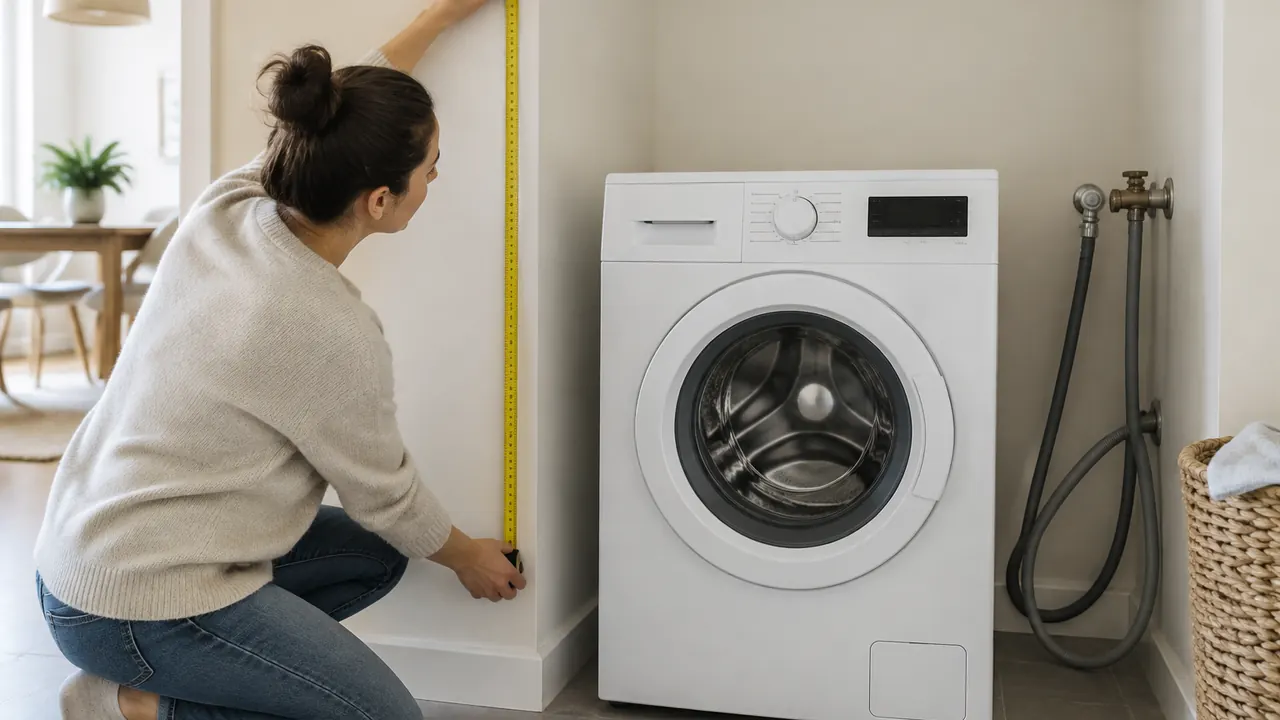
Measure with the installation drawing for the exact model in hand. Published appliance dimensions do not always capture the space needed for handles, hoses, ventilation or a fully opening door. Record the opening’s width at the top, middle and bottom, its height at several points, and usable depth. Note baseboards, countertops, trim, uneven floors and anything projecting from the wall. Do not force the appliance into a nominally matching space without the manufacturer’s required clearances.
Then measure the entire delivery route, including doorways, hallways, stairs, landings and tight turns. Share the narrowest dimensions with the delivery company; a doorway’s advertised size is not necessarily its usable opening. Check everyday access, too: refrigerator drawers may need more door swing than you expect, and a front-loading washer needs room to load and unload. If moving an existing machine would expose wiring, strain a gas line or risk injury, leave that step to a professional.
- Record doorway clear width and height, threshold changes, stair width and landing dimensions.
- Measure door and drawer swing against islands, adjacent cabinets and nearby walls.
- Note connection locations and available rear space so hoses and cords will not be crushed.
- For laundry closets, check door interference, ventilation requirements and access for future servicing.
5. Send site photos before accepting the quote
Photos let a seller or installer spot potential exclusions before the delivery truck arrives. Send a wide view of the room and appliance opening, followed by closer images of visible connections. Include a tape measure in a few opening photos, but also provide written dimensions; perspective can distort the reading. Photograph the delivery route’s difficult spots, such as a narrow landing or a doorway immediately beside a wall.
Capture visible water shutoffs, the drain connection, receptacles, gas shutoff where applicable, and the dryer vent connection. A photo of the existing appliance’s model label can help explain what is being replaced. For proposed electrical work, ask the electrician which panel and circuit-label photos would be useful. Never remove a panel cover or disconnect an appliance just to get a picture. Avoid sharing unrelated personal details visible in your home. Ask the estimator to acknowledge the images and list remaining assumptions in writing. Photos support a quote; they cannot establish hidden wiring capacity, pipe condition or code compliance.
6. Assign permits, inspections and removal explicitly
Permit requirements depend on your jurisdiction and the scope of work. A straightforward replacement may be treated differently from a new circuit, relocated gas line or plumbing alteration. Ask the local building department or the appropriate licensed contractor what applies to your address. Your quote should identify who obtains any permit, pays the fees, schedules inspections and handles corrections. A retailer’s installation booking is not proof that those responsibilities have been covered.
Old-unit removal also needs a precise scope. Haul-away may require the appliance to be empty, disconnected and accessible, and it may exclude a unit located somewhere other than the replacement site. Ask whether safe disconnection is included and whether the crew takes the old appliance before or after the new one is tested. For refrigerators, freezers and other refrigerant-containing equipment, use a removal service that follows applicable refrigerant-recovery and disposal requirements; never cut refrigerant lines yourself. If a utility or local program offers pickup or a rebate, verify eligibility and scheduling before arranging competing removal services.
7. Compare the written totals before authorizing work
Put competing worksheets side by side and resolve every unknown that could change your decision. A lower installation charge is not a bargain if another quote includes the required cord, difficult access and haul-away. Ask for an itemized written estimate showing exclusions, any allowances, quote validity and how additional work will be authorized. Confirm whether separate trades will invoice you directly.
Before delivery day, confirm that the selected model and accessories match the order, required preliminary work is complete, and someone authorized to approve changes will be available. At completion, document visible damage or unfinished work, retain receipts and permit records, and ask for the promised operational checks. The useful comparison is not which store displays the lowest appliance price. It is which documented offer gets your chosen appliance safely working in your home for the clearest total cost.
Installation terms, prices and local requirements can change; verify current details with the seller and permitting authority, and use qualified professionals for utility work.
AI Assistance Used — AI assistance was used in researching and drafting this article. It was reviewed, edited, and fact-checked by Jordan Singh before publication.