Basket Air Fryer vs. Air Fryer Toaster Oven: Which Fits Your Meals?
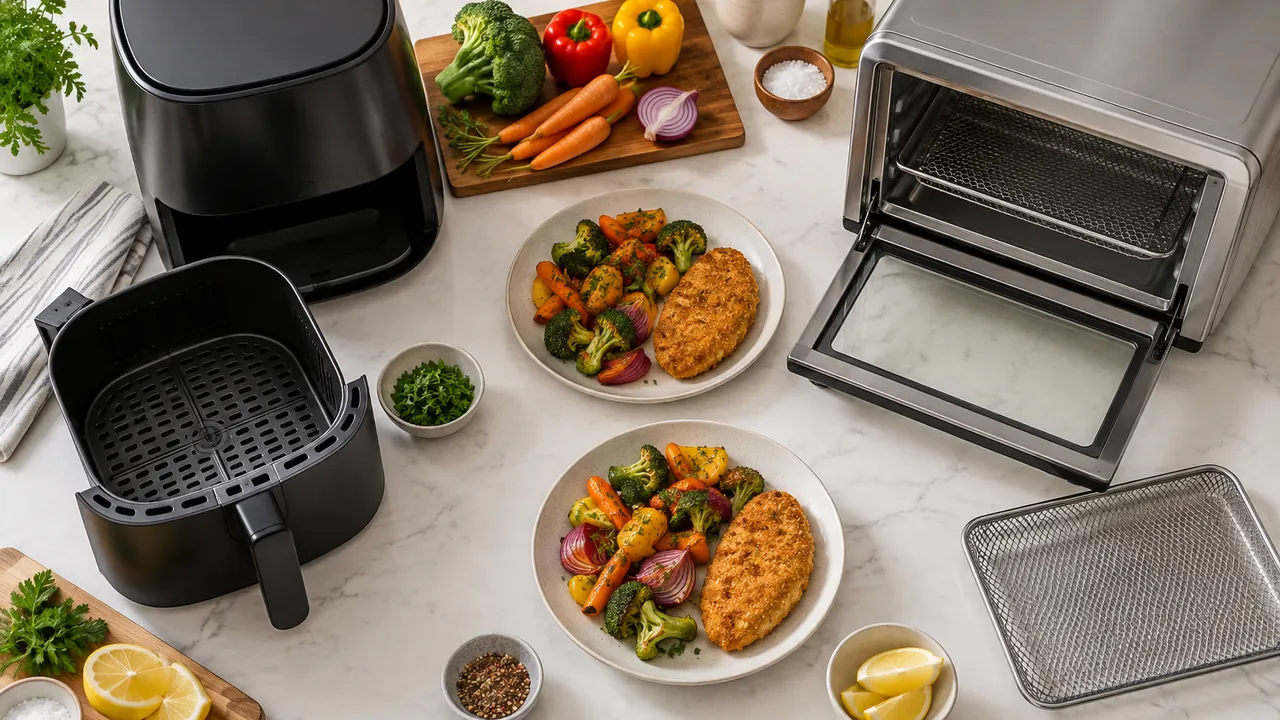
A basket air fryer can turn a modest portion of frozen fries into a quick side. An air fryer toaster oven may fit the chicken cutlets and toast that would otherwise require separate batches. Neither format wins every meal, and advertised quart capacity does little to settle the choice. The practical differences become clearer when you compare a typical weeknight meal rather than a product's largest claimed serving.
Both use heating elements and moving air, but their shapes change how food cooks and how much attention it needs. Start with your usual dinner: how many pieces must lie flat, whether everything needs to finish together and how much counter space can safely remain clear.
1. Measure dinner space, not the advertised quart capacity
For breaded chicken, salmon fillets or sliced zucchini, the useful measurement is the food-supporting surface with room for air to circulate. A deep basket may hold plenty of fries but offer limited space for cutlets. Toaster ovens often provide a wider tray, although usable dimensions vary substantially by model.
Check the manufacturer's manual for basket, rack and tray dimensions, not just exterior measurements. If those are missing, ask the manufacturer or measure a display unit. Two cooking levels do not automatically double crisp-food capacity: an upper tray can obstruct airflow and drippings can affect food below.
Sketch the cooking surface on paper and arrange cutout shapes matching your usual fillets or cutlets, leaving gaps. Rounded basket corners can eliminate space that a rectangular measurement suggests is available. Keep this planning exercise outside the appliance.
- Cutlets: compare the flat footprint without overlapping pieces.
- Fries: distinguish a modest layer from a basket filled deeply.
- Pizza: check rack width, depth and door clearance.
- Dual baskets: check each compartment, not their combined capacity.
2. Match browning to the food and its layout
Basket models often brown small batches efficiently because food sits in a compact cooking chamber with strong airflow. Shaking helps expose fries and vegetable pieces, but crowding still encourages steaming. A tall pile is not equivalent to a single layer, even when it fits below the fill line.
Toaster ovens make it easier to spread out flat foods and watch their color. Depending on the model and rack position, browning may be uneven; rotating a tray or flipping food can help. Mesh trays expose undersides to air, while solid pans catch juices but change bottom browning.
Surface moisture also matters: pat washed vegetables dry before adding a light coating of oil. For comparisons, use equal weights, similar piece sizes and the same preparation; otherwise, wetter ingredients can make one appliance appear less capable of browning.
| Common meal | Useful starting point | Main limitation |
|---|---|---|
| Fries for two | Basket | Deep piles need shaking |
| Several breaded cutlets | Wide oven tray | Check spacing and rotation |
| Toast and open-faced sandwiches | Toaster oven | Inspect coverage and toast consistency |
| Roasted vegetables | Either format | Avoid crowding wet vegetables |
3. Count preheating and every batch before judging speed
A basket model may reach cooking conditions faster than a larger toaster oven, but wattage, controls and chamber design matter. Some instructions call for preheating; others provide timings from a cold start. Follow the appliance manual and recipe rather than assuming that every air fryer can skip preheating.
The meaningful comparison is time until everyone can eat. One larger tray of chicken may beat two basket batches despite a longer warmup. Conversely, heating a larger chamber for one leftover slice may offer little benefit. Keep finished batches warm safely, recognizing that holding can soften crisp coatings.
For dual-basket models, check whether published cooking times apply when both compartments run. Some appliances manage shared power differently during simultaneous cooking. A synchronized-finish setting coordinates timers, but it does not confirm that either food is done.
- Include loading, shaking, flipping and unloading in your estimate.
- Check whether chicken and vegetables need different temperatures.
- Use a food thermometer; poultry should reach 165°F under USDA guidance.
4. Compare cleanup after a messy meal
A removable basket and crisper plate can make cleanup straightforward after nuggets or vegetables. Grease can still collect underneath the insert, around drawer edges and near the heating element. Dishwasher-safe labeling applies only to specified parts; consult the manual before putting a coated basket or tray in the dishwasher.
A toaster oven may leave you washing a mesh basket, drip pan and crumb tray, plus wiping splatters from the cavity and door. Cheese, sugary sauces and chicken fat expose this difference quickly. Unplug either appliance and let it cool before cleaning; never immerse the main unit.
Measure removable parts against your sink, too: a wide oven tray may be awkward to scrub in a small basin. Check replacement-part availability before buying, especially for coated crisper plates and mesh baskets that can become damaged.
- Check whether the drip-catching parts remove easily.
- Use nonabrasive tools on coated surfaces.
- Follow liner instructions; loose parchment can reach heating elements.
5. Plan operating clearance before choosing a winner
Exterior dimensions tell you whether an appliance fits, not whether it can operate safely there. Required rear, side and overhead clearances vary by model, so use the official installation or safety instructions rather than a universal inch rule. Keep vents unobstructed and check restrictions involving overhead cabinets, walls and heat-sensitive surfaces.
Check the electrical setup as well as the footprint. Running an air fryer alongside a kettle or microwave on the same circuit can overload it. Follow the manufacturer's outlet requirements and avoid power strips for these high-wattage appliances.
Allow space to pull out a basket or lower an oven door, plus a heat-safe landing spot for hot parts. Check cord reach without assuming an extension cord is acceptable. Choose a basket for smaller, shakeable portions and simpler cleanup; favor a toaster oven for wider meals, toast and fewer batches—provided the required operating space fits.
As of October 2026, verify dimensions, clearances, cleaning instructions and recalls through manufacturers’ official manuals and the US Consumer Product Safety Commission.
AI Assistance Used — AI assistance was used in researching and drafting this article. It was reviewed, edited, and fact-checked by Jordan Singh before publication.